
No products in the cart.
WASTE MANAGEMENT · 01 Commercial Evaluation
Smart Bin Overflow Detection with Edge AI: Vision AI Cameras vs Traditional Sensors
Ultrasonic fill sensors, infrared detectors, and manual inspection have been the default tools for bin monitoring for decades. Each carries a different set of tradeoffs. This article breaks down how they actually perform — and where Vision AI running on an edge camera changes what’s measurable, reliable, and cost-effective at scale.
The Real Cost of a Bin That Overflows
A waste bin overflowing on a public street is not just an aesthetic problem. For city operations teams, it triggers an unplanned dispatch — breaking an already-optimised route, burning extra fuel, and absorbing a driver’s time that was budgeted elsewhere. For a shopping centre operator, it generates a maintenance complaint, a potential hygiene inspection flag, and a direct reputational impact visible to every customer who walks past.
For most organisations, the immediate answer has been to increase collection frequency across all bins — a blunt instrument that raises costs without solving the underlying problem. The underlying problem is simple: without real-time fill-level data, you can’t know which bins actually need attention. Monitoring is the prerequisite for optimisation.
40%
Of collection runs arrive at bins that are less than half full (Bigbelly Smart Cities
data)
30%
Potential fuel cost reduction with real-time fill monitoring and dynamic routing
(SmartEnds pilot, 2023)
60%
Reduction in public complaints reported after AI-driven monitoring deployment (India
urban pilot, 2023)
94.1%
Overflow prediction accuracy with machine learning on fill-level time-series
(peer-reviewed, 2023)
The monitoring technology you choose determines the quality of data that flows into every downstream decision — routing, scheduling, contractor SLA verification, ESG reporting. It’s worth being precise about what each approach actually delivers.
How Traditional Monitoring Approaches Work — and Where They Fall Short
Three technologies dominate legacy bin monitoring deployments. Each has been in active use long enough to have well-documented failure modes.
Ultrasonic Sensor
Distance-based fill measurement
Advantages
- Mature, well-understood technology
- Very low power draw
- No privacy concerns
- Simple data output (distance in cm)
Limitations
- Irregular waste (bags, large items) causes false readings
- Foam, soft waste absorbs sound waves, reducing accuracy
- No visual confirmation — can’t distinguish compacted vs. loose fill
- No evidence for SLA disputes or compliance audits
- Single-class output only: a distance number
Infrared (IR) Sensor
Beam-break fill detection
Advantages
- Extremely low cost per unit
- Simple binary output (full / not full)
- Very long battery life
Limitations
- Binary by design — no fill-level gradients
- Transparent bags, liquids, or reflective objects defeat the beam
- Dust and debris contamination causes sensor failure
- Single-point detection only; misses side-piled waste
- No image data for downstream analysis
Manual Inspection
Staff-based visual check
Advantages
- No hardware cost or maintenance
- Contextual judgment (abnormal situations)
- No connectivity requirement
Limitations
- Not continuous — misses rapid fill between visits
- Labour cost scales linearly with bin count
- Inconsistent reporting across staff
- No data trail for trend analysis or reporting
- Impractical for remote or high-density networks
* Accuracy figures are field-reported estimates across mixed-waste environments. Performance degrades significantly with irregular or compacted waste profiles. Sources: IoT Analytics Smart Waste Report 2023; ISWA technical working papers.
The core problem shared by all three approaches
Ultrasonic, IR, and manual inspection share a fundamental constraint: they produce a single measurement at a single point in timeNone produce image evidence. None can distinguish between waste types, contamination, or conditions that affect collection priority differently — a bin that appears 70% full by distance but contains hazardous spill material is not equivalent to one that’s 70% full of dry paper.
How Vision AI Works Differently
An edge AI camera — like the CamThink NeoEyes NE301 — doesn’t measure a distance or break a beam. It captures an image of the bin’s current state and runs an AI inference (applying a trained model to new data to produce a classification result) directly on a built-in NPU (Neural Processing Unit). The result — a fill-level class and confidence score — is produced entirely on-device, in under 50ms, with no cloud dependency.
This architectural difference has practical consequences across every dimension that matters for operational deployment.
Multi-State Classification, Not Binary Thresholds
Where ultrasonic returns a distance and IR returns a boolean, a Vision AI model returns whatever classes you trained it on. A typical waste monitoring model might classify: Empty / Partial / Near-Full / Full / Overflow / Contaminated. Each class maps to a different operational response — partial bins are skipped, near-full bins are flagged for next-route collection, overflow triggers immediate dispatch.
Image Evidence as a First-Class Output
Every classification is backed by a timestamped image. This is not a nice-to-have — it is operationally significant. When a contractor disputes a service-level agreement claim, the image log provides verifiable evidence. When an ESG audit requires documented waste stream data, the image log is the audit trail. When a bin shows anomalous readings, the image confirms whether the cause is actual overflow or sensor occlusion.
Condition-Aware, Not Just Fill-Aware
A Vision AI model trained on appropriate data can classify conditions that distance sensors cannot detect at all: a bin with its lid forced open, waste piled outside the bin perimeter, a bag left beside rather than inside the bin, or a bin that has been tipped. These conditions share the same operational urgency as overflow — but would be invisible to any sensor that only measures fill depth.
Side-by-Side: All Approaches Across Every Operational Dimension
The table below uses dimensions that reflect what actually matters in a production deployment decision — not theoretical specifications.
| Dimension | Manual Inspection | IR Sensor | Ultrasonic Sensor | Cloud Vision API | Edge AI Camera (NE301) |
|---|---|---|---|---|---|
| Fill-level accuracy (mixed waste) | Variable | Low (~50%) | Medium (~70%) | High (>90%) | High (>90%) |
| Multi-state classification | Subjective | Binary only | 3–5 levels max | Custom classes | Custom classes |
| Image evidence per reading | No | No | No | Yes (in cloud) | Yes (on-device) |
| Cloud / internet dependency | None | None | Optional | Always required | Not required |
| Recurring cost per device | High (labour) | Low | Low–Medium | API fee per call | $0 (one-time HW) |
| Battery / outdoor viability | N/A | 2–3 years | 1–2 years | Requires power + data | Months (deep sleep 7–8 µA) |
| Condition detection (spill, tipping) | Yes | No | No | Yes (model-dependent) | Yes (model-dependent) |
| Open integration (MQTT / HTTP) | N/A | Varies by vendor | Varies by vendor | API only | MQTT + HTTP native |
| Model retraining / customisation | N/A | Not possible | Not possible | Provider-dependent | Fully open pipeline |
| Indicative cost (100 bins, 3 years) | $$$$ (labour) | $4,000–$12,000 HW | $6,000–$18,000 HW | $0 HW + ongoing API | $15,990 HW, zero recurring |
Cost estimates based on publicly available 2025 pricing. Cloud API costs vary by provider, call volume, and image resolution. Labour costs excluded from sensor estimates.
Accuracy in Context: What the Numbers Mean for Operations
Abstract accuracy percentages are difficult to interpret operationally. The chart below contextualises fill-level classification accuracy across approaches — and the downstream consequences of each error rate matter significantly at scale.
* Edge AI accuracy figures based on CamThink field validation with NE301 + custom YOLOv8 model. Sensor accuracy figures are field-reported averages across mixed-waste environments from IoT Analytics (2023). Manual inspection consistency estimate from facility management literature; varies significantly by staff training and audit frequency.
At 100 bins monitored 4× per day, a 68% accurate sensor produces approximately 128 false readings every 24 hours. Each false “full” reading risks triggering an unnecessary truck dispatch; each false “not full” reading risks a missed pickup and overflow. At scale, that noise degrades the value of dynamic routing to the point where operators revert to fixed schedules anyway — defeating the purpose of monitoring.
Developer note: tuning confidence thresholds
The NE301’s inference output includes a per-class confidence score alongside the classification label. In MQTT payloads, operators can filter on confidence — for example, only triggering a dispatch alert when both the “Full” class is predicted and confidence exceeds 0.85. This threshold tuning meaningfully reduces false positives without sacrificing recall on genuine overflows. See the MQTT Data Interaction guide for payload schema details.
Matching the Technology to the Deployment Scenario
There is no universal answer. The right monitoring approach depends on the specific constraints of each deployment context. The following scenarios reflect the most common configurations we see evaluated by system integrators and facility operators.
A
High-traffic urban public bins with no mains power
Transit hubs, park entrances, commercial streets. These bins have the highest overflow risk and the most constrained installation conditions — no power, no wired connectivity, exposed to weather. Battery-powered operation is essential; WiFi is unreliable; cellular is the right connectivity path.
→ Recommended: NE301 (cellular variant, battery / solar)B
Commercial property waste rooms and loading docks
Shopping centres, supermarkets, office parks. These locations typically have mains power, internal WiFi, and a contracted waste removal SLA that needs monitoring. Image evidence for SLA disputes is high-value. A permanent PoE-powered installation is appropriate.
→ Recommended: NE301 (PoE-powered, WiFi 6)C
Large-scale pilot program across 50–200 bins
Municipal proof-of-concept deployments or campus-wide rollouts where cost per unit is the binding constraint. Initial accuracy requirements may tolerate slightly lower fill-level granularity in exchange for rapid deployment across a broad coverage area.
→ Recommended: NE101 (event-triggered, 2–3 year battery, $69.90)D
Multi-stream recycling stations requiring type classification
Four-stream recycling points (general waste, paper, glass, plastic) in campuses or transit hubs. Single-sensor approaches cannot distinguish waste type. A Vision AI model trained with recycling-specific classes handles type identification and contamination detection simultaneously.
→ Recommended: NE301 with custom multi-class modelE
Enterprise campus or hospital with 50+ bins and existing infrastructure
Large enclosed facilities with dense bin networks, existing building management systems (BMS), and a requirement to aggregate data centrally. Multi-camera aggregation via a server-grade edge device is appropriate for fleet management, work-order automation, and integration with BMS or SCADA platforms.
→ Recommended: NE301 fleet + NeoEdge NG4500 hubThe NE301 as a Bin Monitoring Platform
The CamThink NeoEyes NE301 was designed specifically for always-on edge AI inference in resource-constrained environments — which maps directly to the requirements of outdoor bin monitoring. Its specification is not aspirational; it has been validated in a documented urban waste monitoring deployment. The full case study is available in the CamThink Wiki.
Primary Node · On-Device AI Camera
NeoEyes NE301
$199.90
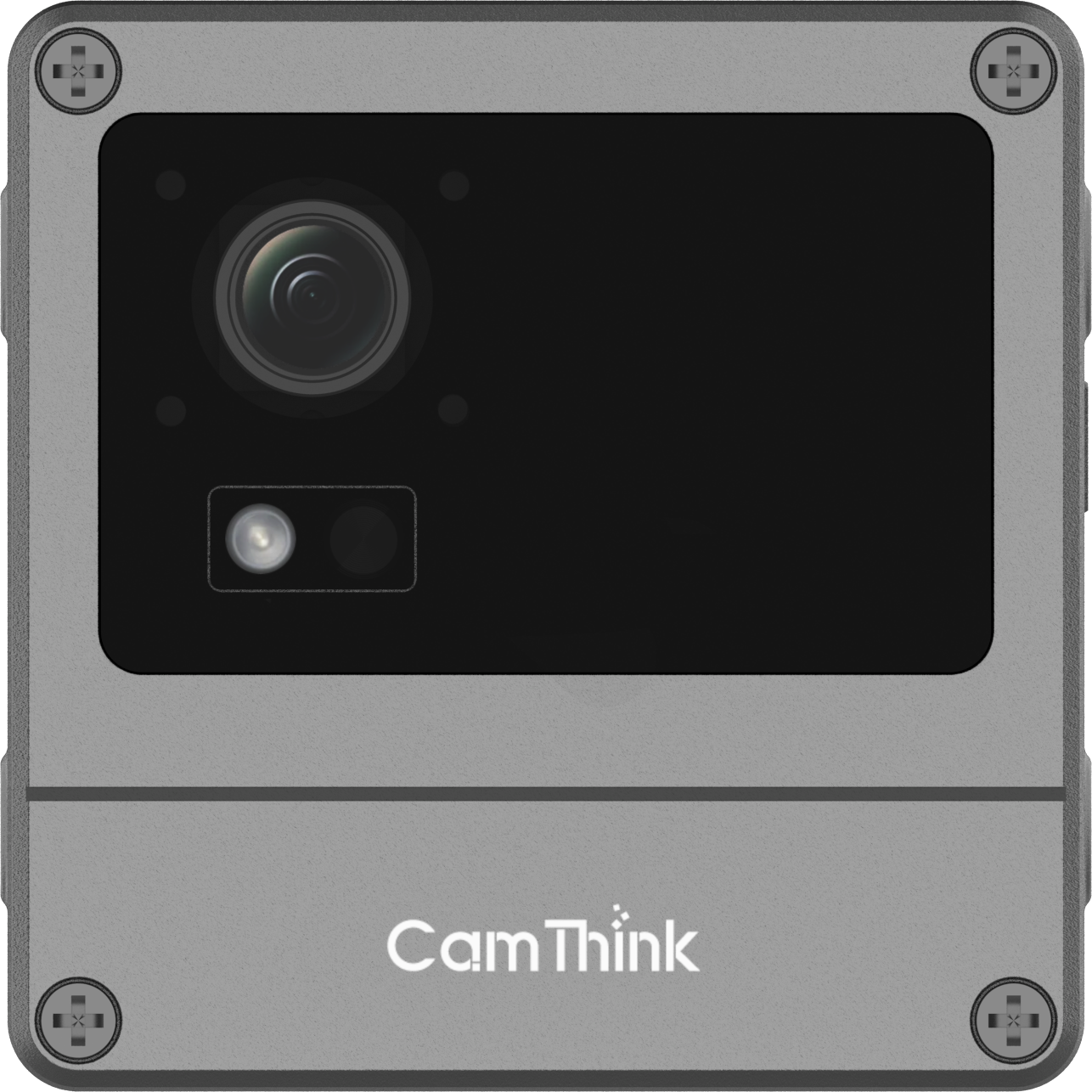
- STM32N6, Cortex-M55 + Neural-ART NPU — 0.6 TOPS on-device AI inference
- 4MP MIPI CSI sensor — 51° / 88° / 137° FOV options
- WiFi 6 + BT 5.4 · optional 4G LTE or PoE
- Deep sleep: 7–8 µA · Full run: 170–180 mA
- AA Battery powered, USB-C 5V or PoE
- IP67 weatherproof · 77 × 77 × 48 mm
- Open firmware · YOLOv8 native · Browser-based Web UI
- MQTT + HTTP output · Home Assistant compatible
Key Capability: What the NE301 Actually Does Differently from Sensors
Three capabilities separate the NE301 from sensor-based alternatives in a waste monitoring context, beyond the accuracy and multi-class advantages already discussed.
Model ownership. The model running on the NE301 is yours — trained on your specific bin types, your lighting conditions, and your waste profiles. The CamThink AI Tool Stack supports end-to-end training from image collection through INT8 quantization to deployment, entirely via browser. No Python environment, no GPU, no AI expertise required to retrain as conditions change.
Zero per-inference cost. Unlike a cloud Vision API where every image processed incurs a fee, the NE301’s NPU runs inference locally with no per-call cost. At 4 captures per hour across 100 bins, that’s 9,600 inferences per day — which would generate meaningful cloud API costs at scale, but costs exactly $0 on the NE301.
Operational continuity during connectivity loss. Because inference is on-device, a bin continues to be monitored even if cellular or WiFi connectivity is temporarily interrupted. The device buffers results and transmits when connectivity is restored — rather than producing a gap in the monitoring record.
Known limitation: model performance in low-light conditions
The NE301’s 4MP sensor performs reliably in typical ambient and artificial lighting. In outdoor deployments without illumination, nighttime classification accuracy degrades. For 24/7 monitoring in unlit outdoor environments, either restrict active monitoring to daylight hours via MQTT scheduling, add a low-power IR illuminator, or include low-light images in the training dataset. Validate under your actual deployment conditions before relying on nighttime data for routing decisions.
How to Make the Decision for Your Deployment
The choice between sensor-based monitoring and Vision AI is rarely about one dimension alone. It’s about the aggregate fit between what the technology produces and what your operations actually need to act on. Use the following three questions to frame the evaluation.
1. Do you need evidence, or just a signal?
If your monitoring output is consumed by an automated routing algorithm and no human ever needs to verify or dispute a reading, ultrasonic sensors may be sufficient — particularly for uniform waste streams in clean environments. If you need to validate contractor SLA compliance, support ESG reporting, investigate complaints, or train staff, image evidence is not optional.
2. Will your waste profile change?
Sensor-based systems are calibrated for a fixed bin geometry and waste type. If bin types change, if new waste streams are introduced, or if seasonal usage patterns shift dramatically, sensor accuracy degrades without recalibration. A Vision AI system with a retrainable model adapts to these changes — you update the training data and redeploy. The underlying hardware remains unchanged.
3. What is the true cost at your target scale?
For 10 bins, the economics of sensor vs. camera look similar. For 100 bins, the ongoing cost differentials — cloud API fees vs. zero; sensor maintenance vs. firmware update — compound significantly. Build a 3-year TCO model that includes hardware, connectivity, maintenance, and platform costs before committing to either approach at volume.
See it working: Full deployment walkthrough
The CamThink Wiki documents a complete NE301 waste bin monitoring deployment — from hardware installation through model training, MQTT configuration, and Home Assistant dashboard integration. All steps are reproducible with off-the-shelf hardware. Read the full case study →
Frequently Asked Questions
Can the NE301 replace an existing ultrasonic sensor deployment without re-wiring?
In most cases, yes — the NE301 can be mounted externally on or adjacent to a bin without accessing internal wiring. It supports PoE (Power over Ethernet), USB-C power, or battery operation, so it adapts to available power infrastructure. The cellular (LTE Cat.1) variant requires no wired connectivity at all.
If your existing sensors transmit to a central MQTT broker, the NE301 publishes to the same protocol, allowing a phased migration — running both systems in parallel before fully decommissioning sensors.
How many images per day does the NE301 capture in a typical waste monitoring deployment?
Capture frequency is fully configurable. Typical waste monitoring deployments use 1–4 captures per hour (24–96 images per device per day), which balances monitoring granularity against data volume and power draw. For battery-powered deployments, lower frequency (1× per hour or event-triggered only) significantly extends battery life.
The device can also be triggered on-demand via a downlink MQTT command — useful for manual
checks before scheduled collection or after an overflow alert has been acknowledged.
What is the minimum number of training images needed to get a reliable model?
For a 2-class model (e.g., Full / Not Full), reliable initial performance requires approximately 100–200 images per class covering the range of conditions in your deployment — different fill levels, lighting angles, bin types. For a 4–6 class model with nuanced gradations, 300–500 images per class is the recommended minimum before production deployment.
The NE301 can function as its own data collection device — pointing it at the bins during normal operation and labelling captured images via the AI Tool Stack accelerates dataset construction significantly.
Does Vision AI monitoring raise GDPR or privacy concerns in public spaces?
This depends on camera placement and jurisdiction. The NE301 does not record continuous video — it captures individual frames at intervals or on-trigger. If cameras are positioned to frame only the bin interior or immediate bin area, the risk of incidental capture of individuals is minimal.
In EU jurisdictions, even non-continuous image capture in public spaces may require a Privacy Impact Assessment depending on the specific placement. We recommend reviewing with your data protection officer before outdoor deployment. The NE301’s edge-inference architecture means images can be processed and discarded locally — only the classification result needs to leave the device — which materially simplifies data minimisation compliance.
Can the same NE301 unit be retrained as requirements change?
Yes. The NE301 accepts new model packages (.bin format) uploaded via the browser-based Web UI.
You can retrain a model via the AI Tool Stack — for example, to add a new waste class, adjust for a new bin
type, or improve low-light performance — and deploy it to devices remotely over WiFi or cellular. The
existing model continues running until the upload completes and the device restarts.
What happens if the cellular connection drops during a deployment?
AI inference continues running on-device regardless of connectivity — the bin is still monitored. The NE301 buffers classification results locally and transmits them when connectivity is restored. The number of results that can be buffered depends on your configured payload size and the device’s local storage, but typical MQTT payloads (JSON text + optional small JPEG) allow for many hours of buffering without data loss.
Vision AI for Waste Management — Content Series
★
The Complete Guide to Vision AI for Smart Waste Management
All audiences — full topic overview and technology landscape
1
Smart Bin Overflow Detection: Edge AI vs. Traditional Sensors ← You are
here
Procurement & technical evaluators
2
Wiki Full Guide – Urban Waste Bin Overflow Monitoring (NE301 + Home
Assistant)
Developers & system integrators — full technical walkthrough
3
Demand-Driven Waste Collection: ROI Analysis with Real Data Coming Soon
City managers, facility operators, ESG leads
4
How to Build a Smart Waste Monitoring System (Open-Source Stack) Coming Soon
Edge AI developers — hands-on tutorial
5
Smart Waste Management for Municipalities: Procurement & Implementation
Guide Coming Soon
Municipal buyers, facility managers