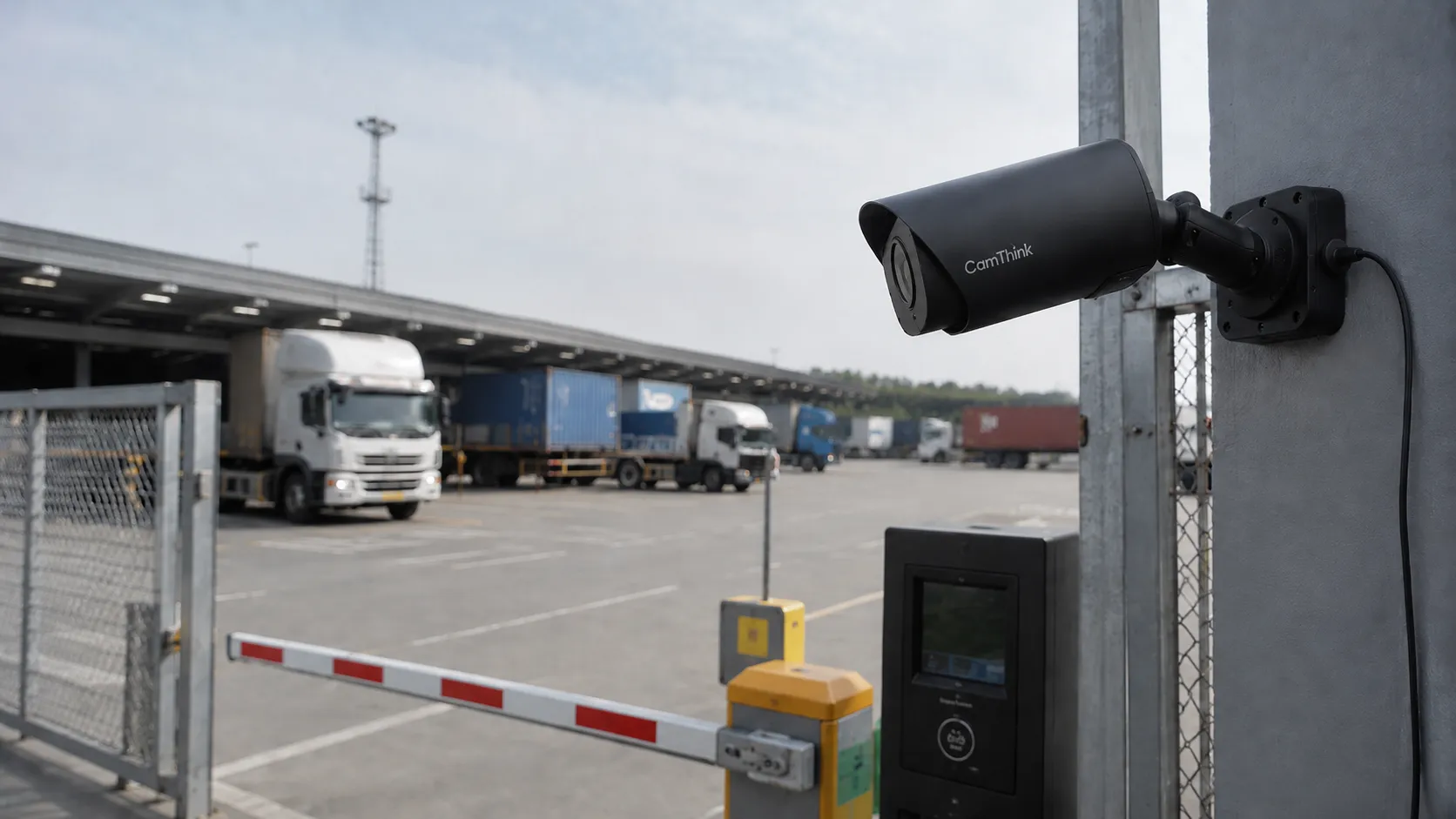
Traditional IP Camera vs Edge AI IPC: When to Upgrade to NeoEyes NE503
A traditional IP camera outputs video. An AI IPC outputs structured events, local inference results, and application runtime at the camera endpoint. This comparison is for system integrators, algorithm companies, AI platform teams, and OEM/ODM teams deciding which vision architecture can become part of their product or system.
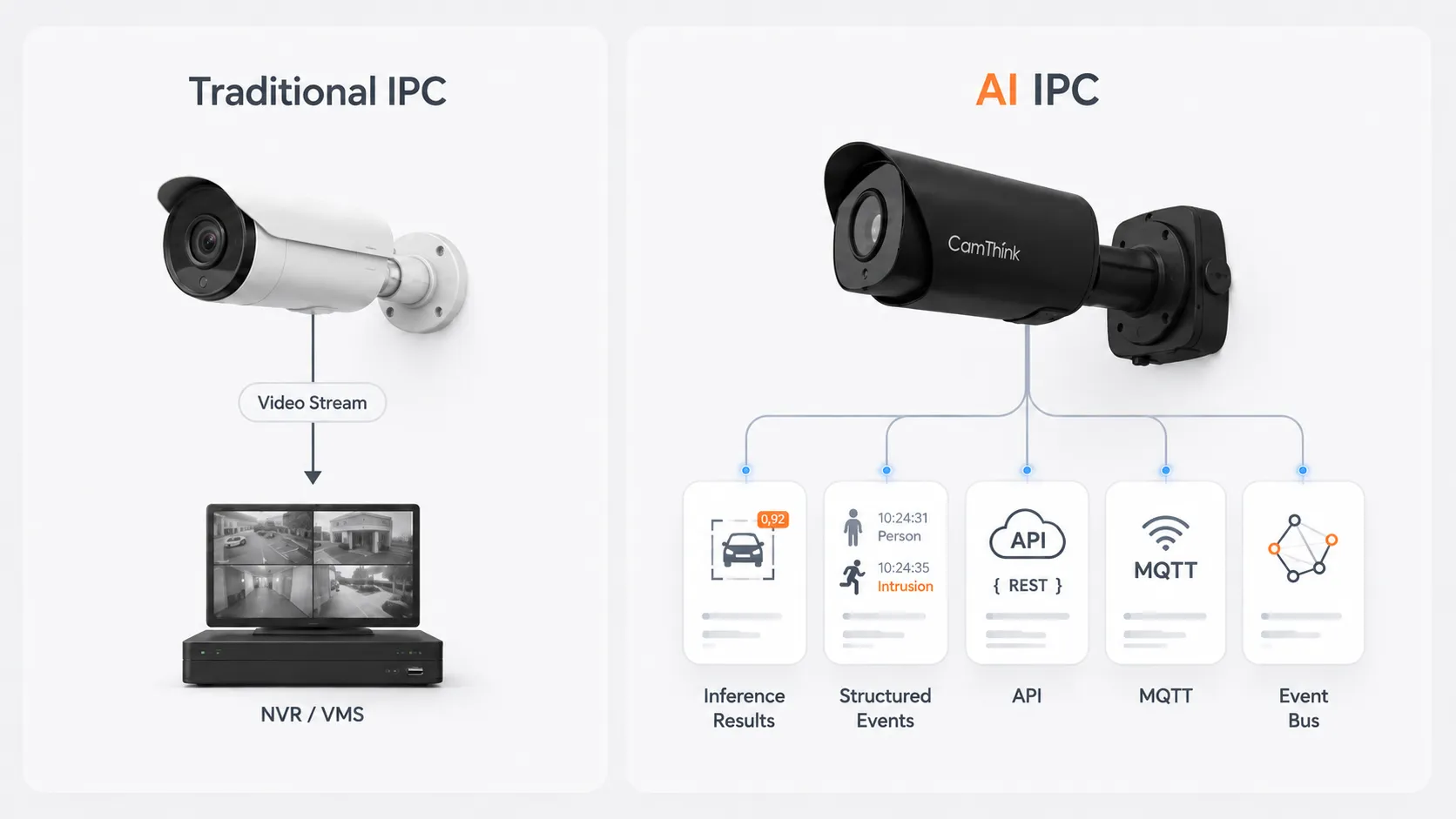
A traditional IP camera is built around one output: a video stream. An AI IPC is built around a different output model — visual input plus local inference results, structured events, and application runtime capability, all produced at the camera endpoint itself.
This is not primarily a resolution difference, a network difference, or a features-in-the-menu difference. It is an architectural difference. When the output changes from a video stream to structured events and application behavior, the role the camera plays inside a system changes completely.
Scope of this article
This guide covers fixed-site AI IPC deployments — always-on, PoE-powered, high-compute camera endpoints that need to run inference and integrate with business systems. Battery-powered and low-power edge cameras serve a different role and are covered separately.
Who is making this decision?
This comparison is especially useful for system integrators connecting cameras to VMS, IoT, access-control, or business platforms; algorithm companies that need a field-deployable runtime for their models; AI platform teams that need visual events instead of raw video; and OEM/ODM teams turning a camera, application, and connectivity stack into a repeatable product.
A Traditional IP Camera Is a Video Endpoint
A traditional IP camera is designed to capture, encode, and transmit video over a network. In most deployments, it sends an RTSP stream or ONVIF-compatible video feed to an NVR, VMS, server, or cloud platform. Recording, analytics, alarm rules, and business logic happen somewhere else — on a server, in the cloud, or inside the VMS.
This architecture works well when the project is video-first. A warehouse, retail site, office building, school, or parking lot that only needs continuous recording and remote viewing does not necessarily need anything more than a traditional IPC. The camera captures footage. The VMS stores it. Operators review it when needed.
The limitation appears when video is no longer the deliverable. More cameras create more footage — but more footage does not automatically create better operational visibility. A site with 50 cameras does not become easier to manage simply because all video is recorded. If teams still need to watch live feeds, manually search playback, or wait for server-side analytics, the camera system remains recording-first.
What a traditional IPC answers
“What happened on video?” — but not: “What is happening now, what does it mean, and what should happen next?”
An AI IPC Is an Intelligence Endpoint
An AI IPC is designed to process visual data locally and output actionable information. The core output of an AI IPC is not only a video stream. It is visual input + local inference + structured events + application runtime.
An AI IPC can run object detection, OCR, license plate recognition, PPE detection, face detection, pose estimation, behavior analysis, ReID, or custom vision models — at the camera endpoint itself. Instead of sending every frame to a server for interpretation, the device analyzes the scene locally and outputs only the results that matter: object class, location, confidence score, timestamp, event type, device status, and action trigger.
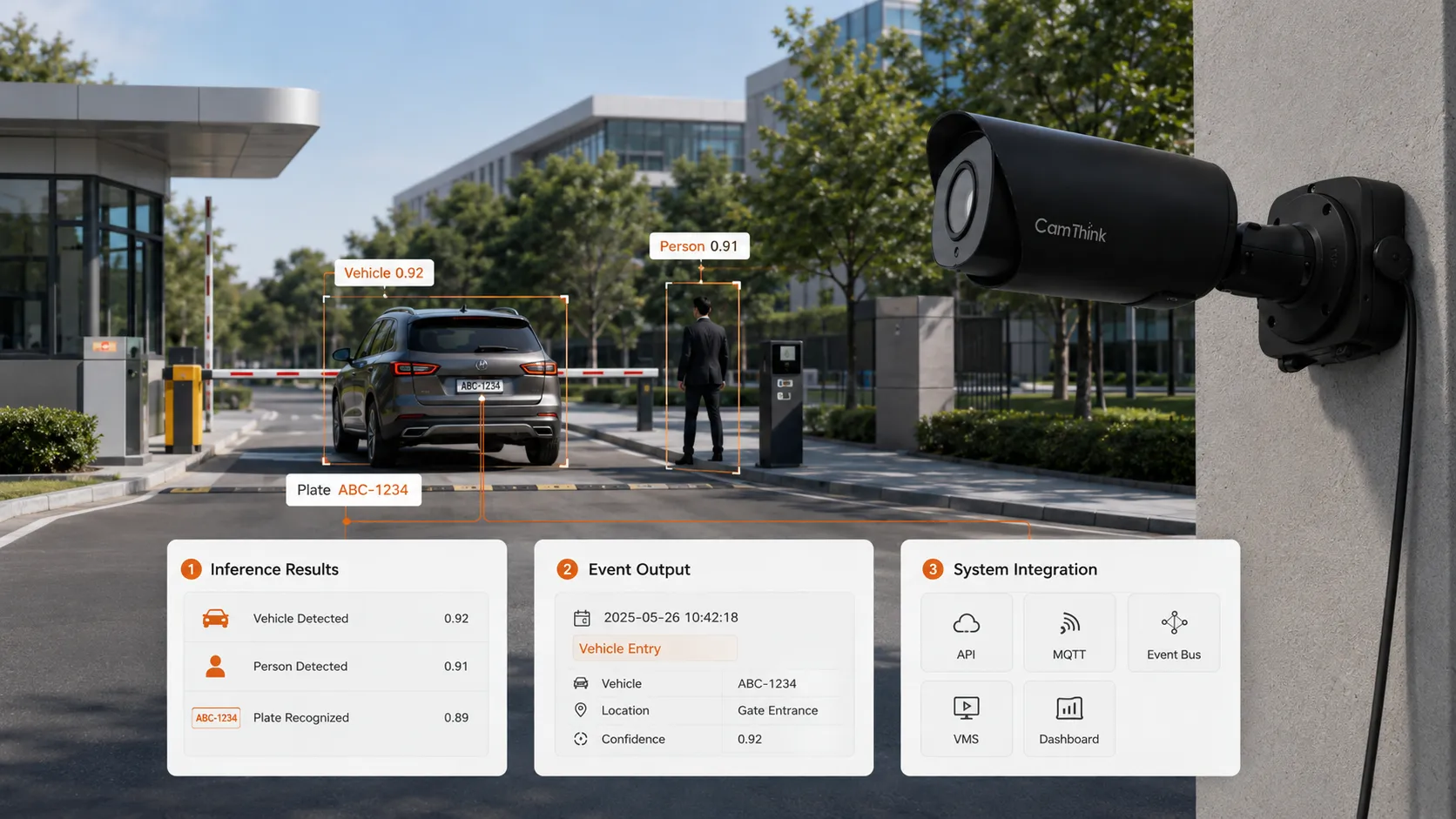
For example: a traditional IP camera may stream 4K video of a gate entrance. An AI IPC at the same gate can detect a vehicle, read a license plate, publish a structured MQTT event, trigger an alarm output, send metadata to a parking platform — and still provide an RTSP stream for VMS recording. That is a meaningfully different class of device.
The camera is no longer just part of the surveillance layer. It becomes part of the edge AI, automation, and integration layer.
The Workflow Shift: Video Stream vs. Structured Event
The most practical way to see the difference is to look at what each architecture produces and what happens next.
In a traditional IPC architecture, the workflow looks like this:
Traditional IPC workflow
📷
IP Camera
Capture & encode
→RTSP / ONVIF
🖥️
NVR / VMS
Record & store
→Server-side
🔍
Analytics
Review & alert
→Manual
🔔
Alert
Human review
In an AI IPC architecture, the workflow changes:
AI IPC workflow
🤖
AI IPC
Capture + Infer
→On-device
⚡
Structured Event
JSON / MQTT
→Direct output
🔗
API / SCADA
IoT · BMS · VMS
→Automated
⚙️
Action
HW · Software
A video stream is useful for human review. A structured event is useful for software systems — VMS recording, business platform integration, SCADA triggers, IoT dashboards, alarm systems, and custom workflow engines all need machine-readable output. That is why an AI IPC is not simply a better camera. It is a camera that can participate in a software-defined workflow.
Head-to-Head: Traditional IPC vs AI IPC
Dimension
Typical video-first IPC
NeoEyes NE503 · AI IPC
Primary output
Typically RTSP / ONVIF video streams
Structured events + RTSP stream
On-device AI inference
Often limited or vendor-defined; advanced analytics may run on a server or in the cloud
20 TOPS local inference (Hailo-15H)
Custom model deployment
Usually unavailable or restricted to vendor-supported models
Containerized apps via Web Console
Integration output
Primarily video; event and API support varies by vendor
MQTT · REST API · Event Bus · RTSP
Local hardware action
Alarm I/O and linkage capabilities vary by model
Alarm I/O · RS-485 · Wiegand
Application runtime
Typically a fixed vendor feature set
Open containerized deployment
Sensor / imaging
Standard IPC sensor
Sony IMX678 4K · Gen2 AI-ISP
Multi-model concurrency
Limited or vendor-dependent
Multiple models run simultaneously
Privacy / data locality
Video is often streamed or recorded externally; local storage and privacy features vary
The project can output events, RTSP video, or both according to its system design
Network dependency
Typically depends on network streaming; local recording options vary
Works offline, events sync when online
Power
Standard PoE
PoE 802.3AT · IP67 · IK10
Best fit
Recording-first surveillance
Automated AI vision workflows
AI IPC specification reference: CamThink NeoEyes NE503 · Hailo-15H SoC · Sony IMX678 · Containerized application deployment
Traditional IP Camera vs Edge AI Box vs NE503
A useful product decision is not only “traditional camera or AI camera.” Many projects must choose between intelligence at the camera endpoint and intelligence in a separate edge computer. The right choice depends on camera count, compute location, application ownership, integration requirements, and field constraints.
Decision factor
Traditional IP Camera
External Edge AI Box
NeoEyes NE503
Primary role
Capture, encode, stream, and record video.
Centralize AI compute and aggregate one or more camera streams.
Capture, infer, run application logic, and output events at a fixed camera position.
Where AI runs
Usually in a VMS, server, cloud, or vendor-defined camera function.
In a separate compute device connected to the cameras.
Inside the camera endpoint through local Hailo-15H inference.
Custom application
Usually limited to the vendor feature set.
Flexible, but requires separate deployment, power, networking, and maintenance.
Containerized application deployment; confirm model and runtime compatibility in PoC.
Camera scale
One video endpoint per camera; analytics usually scale elsewhere.
Strong fit for multi-camera aggregation and centralized compute.
Strong fit for distributed, high-value camera positions; not a replacement for every multi-camera edge box.
System output
Primarily RTSP/ONVIF video; event and API support varies.
Inference results and APIs from the box, with additional camera-to-box integration.
RTSP, MQTT, REST API, Event Bus, and hardware I/O depending on the project contract.
Field deployment
Simple camera and network installation.
Camera plus compute box, power, cabinet space, and additional maintenance.
PoE camera endpoint with local AI and application output at the installation point.
Best fit
Recording-first surveillance.
Multi-camera AI, centralized orchestration, or heavier compute workloads.
A single high-value fixed site that needs local vision intelligence and product/system integration.
Decision boundary
There is no universal winner. Validate the target model mix, camera count, input resolution, latency, network behavior, cabinet constraints, and downstream event contract before choosing between a camera endpoint and a separate edge AI box.
Choosing the Right Tool for the Right Workflow
The right choice depends less on the industry name and more on what the camera must produce inside your system. Here is a straightforward decision framework.
Traditional IPC
Choose a traditional IP camera when:
The main requirement is surveillance recording and VMS playback
Your VMS or NVR already handles all analytics server-side
The project does not need custom AI models at the camera
The camera does not need to trigger local hardware actions
Network and server dependency are fully acceptable
Cost per camera is the primary decision factor
No structured event output from each camera endpoint is required
AI IPC
Choose an AI IPC when:
Local AI inference is required — without sending all video to the cloud
Structured event output (JSON/MQTT) must integrate with your platform
Custom model or application deployment is needed at the camera
The camera must connect to VMS, MQTT broker, REST API, or IoT/SCADA
Local hardware linkage — alarm output, RS-485, Wiegand — is required
Recognition-grade imaging under low light or long range is required
Privacy-sensitive monitoring must keep raw video on-device
Note that AI IPCs should not be positioned as universal replacements for every IP camera. Not every corridor, storage room, or low-risk monitoring point needs local inference. An AI IPC is built for fixed-site, always-on, high-value deployments where the camera must capture, understand, and act.
Six Questions to Verify Before Buying an AI IPC
A comparison page can explain the architecture, but a high-value B2B purchase should move quickly into verification. These six questions help system integrators, algorithm teams, and OEM/ODM buyers decide what to test before approving a sample or project.
1 · Model compatibility
Can the target model run on the available accelerator path, and what conversion, compilation, input, and pre-processing steps are required?
2 · Event contract
What fields must an event contain — type, timestamp, device identity, confidence, bounding box, image reference, and action status?
3 · System integration
How will results reach the VMS, backend, IoT platform, or business system: RTSP, MQTT, REST API, Event Bus, or hardware I/O?
4 · Failure behavior
What happens during network loss, application restart, device reboot, delayed delivery, duplicate events, or downstream unavailability?
5 · Real deployment performance
What latency, frame rate, accuracy, concurrency, thermal, lighting, and night-performance targets must be measured at the actual camera position?
6 · Lifecycle and scale
How are applications updated, rolled back, monitored, secured, and supported when the project moves from sample to pilot to batch deployment?
Move from comparison to validation. Review the architecture, integration documentation, and PoC checklist before requesting a sample.
The same industry can have deployments that need either architecture. What decides is the workflow at the camera endpoint.
Perimeter intrusion detection
A traditional IPC streams video to a VMS for server-side motion analysis. An AI IPC detects intruders locally, filters false alarms on-device, activates fill light, triggers alarm output, and publishes an event to a security platform — without waiting for a server response. At sites with unreliable connectivity, local inference matters.
License plate recognition
Camera image quality and local inference both matter. The camera needs sufficient resolution and low-light stability to capture plate data reliably. Outputting plate metadata as a structured event (not just video) is what allows the downstream parking or access control system to act on it automatically.
Industrial safety and PPE monitoring
An AI IPC can detect missing PPE, restricted-area entry, unsafe behavior, or equipment status at the edge. The system can trigger local alarms even when cloud connectivity is limited or prohibited by site policy. Server-dependent analytics create latency and failure modes at these sites.
Production line visual inspection
A standard IP camera needs an external AI box or server to run inspection models. An AI IPC can run custom inspection models closer to the image source, reduce system complexity, and output pass/fail results directly to the production control system.
Privacy-sensitive monitoring
Healthcare facilities, financial offices, or government sites often cannot transmit raw video off-site. An AI IPC can analyze video on-device and send only metadata, alerts, or masked outputs — keeping raw imagery local and meeting data governance requirements.
AIoT and smart infrastructure
When the camera needs to talk to MQTT brokers, REST APIs, Event Bus, RS-485 field devices or alarm systems, a platform-style AI IPC becomes more useful than a traditional video endpoint. The camera must participate in the data flow, not just record it.
Evaluating an AI IPC for a fixed-site deployment? The NeoEyes NE503 combines 4K Sony imaging, 20 TOPS Hailo-15H inference, containerized application deployment, and structured event output in one PoE camera. Request a sample or discuss your project requirements.
AI compute matters — but TOPS alone does not make a camera suitable for real deployment. A strong AI IPC needs four things working together.
Visual Input Quality
AI models depend on the image. Poor low-light performance, weak HDR, or unstable focus reduce recognition accuracy before the model even runs.
Local Inference Performance
Latency, bandwidth, and data localization all affect deployment. Running models on-camera reduces dependency on remote servers and enables faster response.
Application Runtime
A fixed vendor analytics menu is not enough. Algorithm vendors, OEM teams, and integrators need to deploy applications, update models, and control permissions.
Integration Output
A detection result that only appears as a bounding box on a video preview is not enough. The result must become a consumable event for VMS, IoT, SCADA, dashboards, or business platforms.
This is why the output model is the central difference. A traditional IP camera outputs video. An AI IPC outputs video, inference, events, and application behavior.
NE503: An Open Edge AI Platform for Closed-Loop Workflows
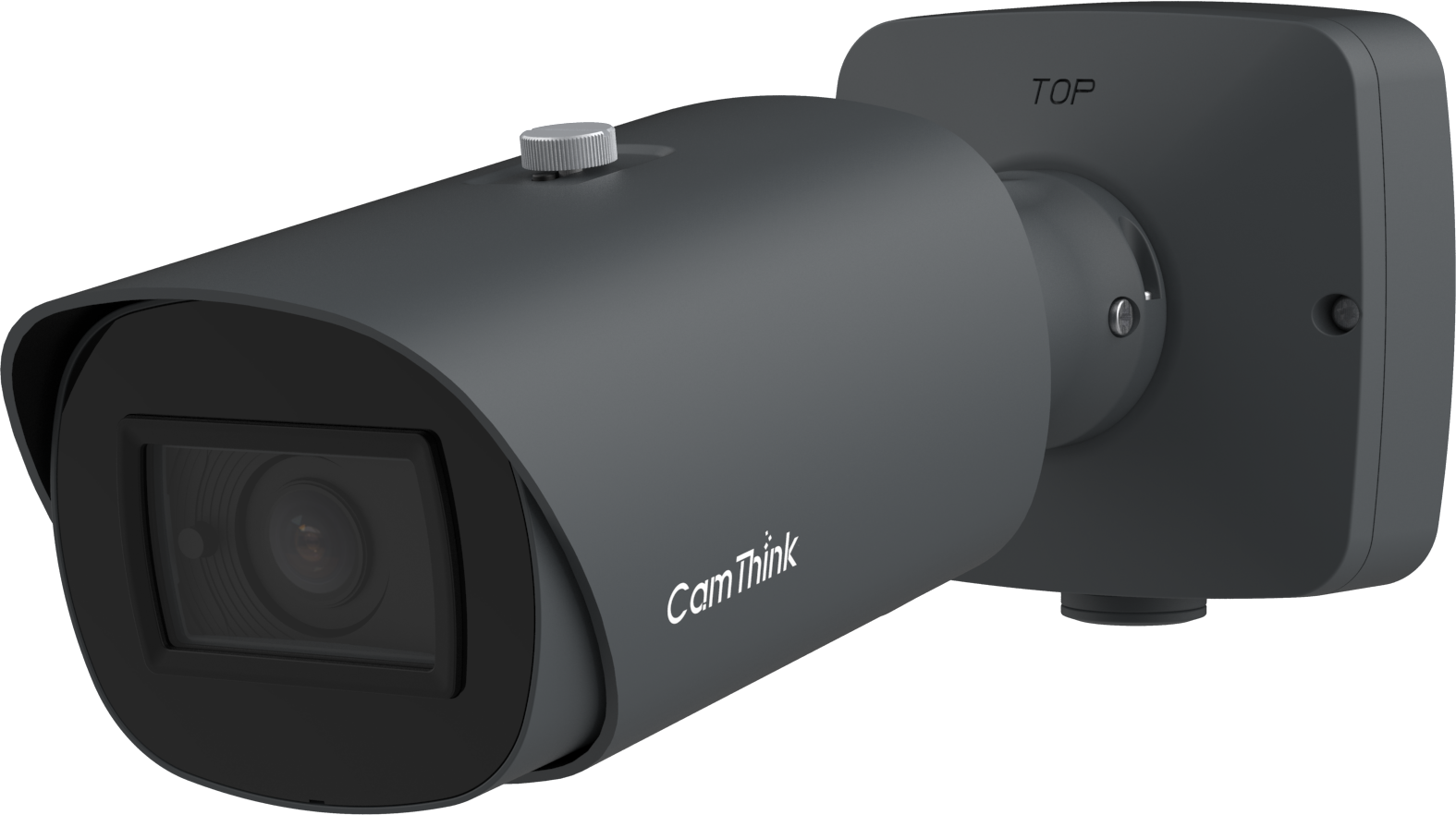
The NeoEyes NE503 is not a traditional IP camera with analytics bolted on. It is designed for fixed-site AI vision projects where the camera endpoint must become part of the application system.
The core value of NE503 is the closed loop: visual input → local inference → application logic → structured event → system integration or hardware action. Each layer feeds the next — without requiring an external AI box or cloud dependency for the primary inference.
In this context, closed-loop describes the workflow, not a closed software platform. NE503 is positioned as an open edge AI camera platform for teams that need to bring their own application logic, produce structured results, and connect the camera endpoint to existing systems or field hardware. Exact model support, event fields, control direction, and lifecycle behavior should still be confirmed in the project documentation or PoC.
NE503 fits projects where the buyer is not only asking “Can this camera record clearly?” — but also asking: Can it run my AI model? Can it output structured results? Can it integrate with my VMS or business system? Can it trigger local hardware actions? Can it reduce the need for a separate edge AI box?
Suitable deployment scenarios include smart security, industrial monitoring, access control, parking and logistics yards, campus gates, production line inspection, and AIoT projects that require local intelligence at the camera endpoint.
NE503 positioning note
NE503 should not be treated as a low-cost replacement for every traditional IPC. It is best understood as an AI IPC platform for deployments where the camera must capture, understand, and act — not simply record.
The Final Decision: Choose the Output You Need
The decision framework is straightforward.
Choose a traditional IP camera if your project needs video coverage, recording, and VMS playback. A traditional IPC is still the right tool when video is the deliverable.
Choose an AI IPC if your project needs visual input, local inference, structured events, and application runtime at the camera endpoint. This is the right tool when the camera must become part of an automated AI vision workflow.
For system integrators, AI solution providers, and OEM teams, this distinction is the core question. It is no longer only “Which camera has the best image?” The better question is: “What should the camera output into my system?”
If the answer is only video, a traditional IP camera may be enough. If the answer is video plus AI results, events, APIs, custom applications, and local hardware actions — the project needs an AI IPC platform.
Frequently Asked Questions
Can an AI IPC still output an RTSP stream for my VMS?
Yes. An AI IPC like the NE503 outputs both a standard RTSP stream and structured events simultaneously. Your VMS can record the video stream while the structured events go to your MQTT broker, REST API, or event bus — there is no trade-off between video recording and AI inference output.
Do I need to replace all my traditional IP cameras with AI IPCs?
No. AI IPCs are not the right tool for every camera position. Corridors, storage areas, low-risk monitoring points, and any position where recording-and-review is the only requirement are still well served by traditional IP cameras. Deploy AI IPCs where the camera must participate in an automated workflow — gates, entry points, production lines, high-value monitoring positions, or any site where structured event output matters.
Can I deploy my own custom AI model on an AI IPC?
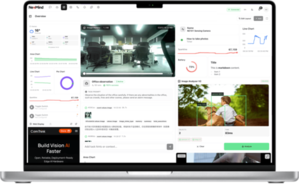
On the NE503, yes. The containerized application architecture allows third-party algorithm providers and OEM teams to deploy custom models through the Web Console. The device supports multiple models running concurrently, and the deployment workflow does not require modifying the camera firmware. This is one of the core differences from traditional IPCs with fixed vendor analytics menus.
What protocols does an AI IPC support for system integration?
The NE503 supports RTSP for video streaming, MQTT for event publishing, REST API for structured queries and control, and Event Bus for application-level integration. On the hardware side, it includes alarm I/O, RS-485, and Wiegand interfaces for direct field device linkage. This range of output options makes it suitable for integration with VMS, SCADA, IoT platforms, BMS, dashboards, access control systems, and custom business platforms.
How does local inference on an AI IPC protect data privacy?
With local inference, the first AI decision can stay on the device. The project can output structured events, RTSP video, or both according to its system design. This means sensitive sites (healthcare, financial, government) can implement AI vision without transmitting raw video to the cloud. The NE503’s 20 TOPS Hailo-15H compute enables this local processing at 4K resolution without requiring cloud dependency.
Is the NE503 suitable for outdoor fixed-site deployments?
Yes. The NE503 is designed for fixed outdoor and indoor deployments. It features an IP67 · IK10-rated enclosure, operates from -40°C to +60°C, and is powered via PoE 802.3AT — meaning a single Cat5e or better cable provides both power and network connectivity. This simplifies installation at gates, yards, facility perimeters, and campus access points.
What is the difference between an AI IPC and an edge AI box connected to a camera?
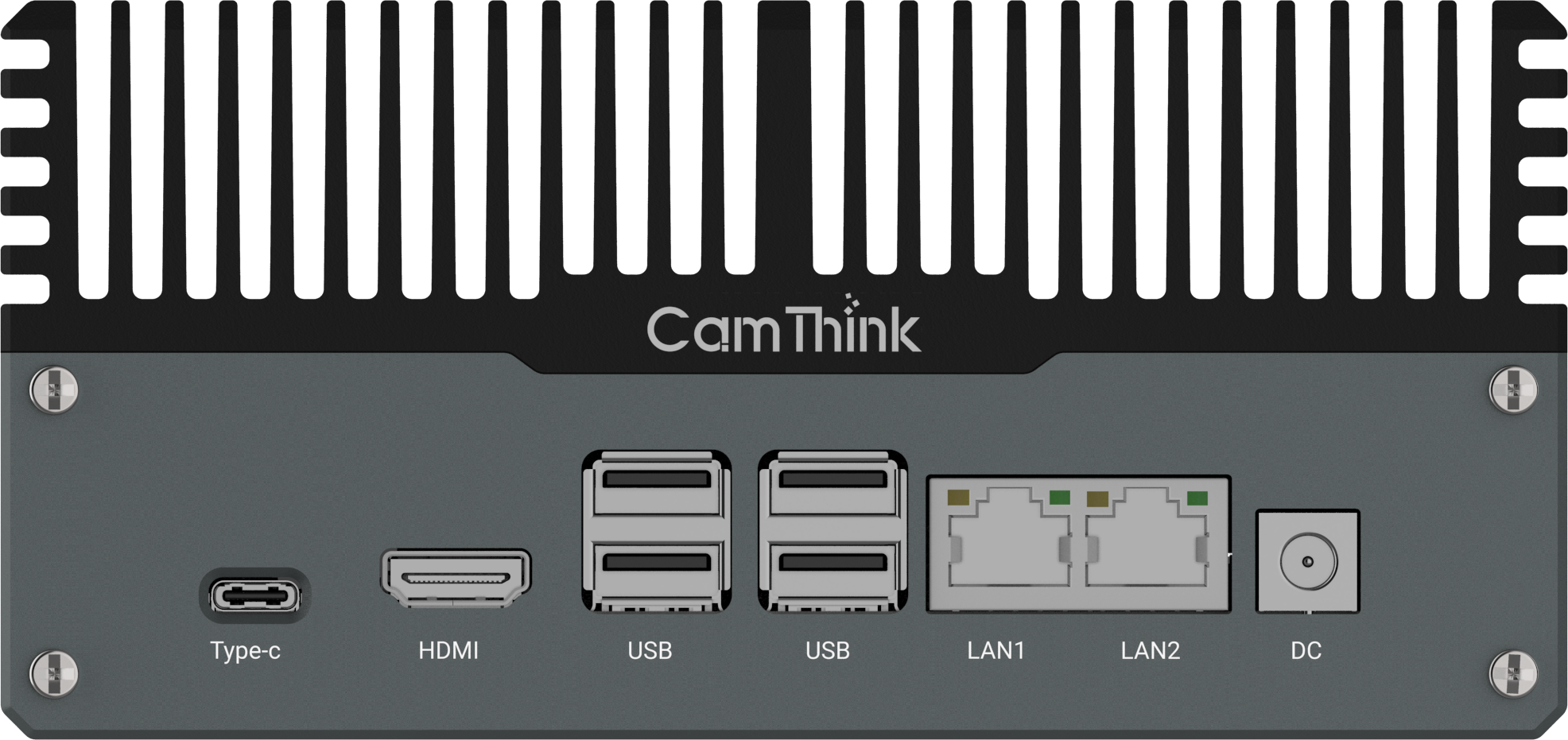
An edge AI box (like the NG4500 with Jetson Orin) is a separate compute device that processes video streams from one or more traditional cameras. An AI IPC integrates compute, imaging, and application runtime inside the camera itself. For fixed single-site deployments, an AI IPC reduces system complexity and eliminates the need for an external box. For multi-camera aggregation, high-compute workloads, or generative AI processing, an edge AI box remains the right architecture.
HH
Harry Hua
Technical Director · CamThink · 10+ years in AI vision and system integration
Harry leads technical product strategy at CamThink, with a decade of experience translating edge AI hardware into real-world deployment architectures for system integrators, OEM teams, and industrial AI solution providers. He works directly with customers across Europe and North America to define integration workflows for AI IPCs, edge compute platforms, and MQTT-driven IoT systems.