Construction Site Security Camera Comparison: Edge AI vs Standard 4G
Compare standard 4G cameras with edge AI systems for construction site security. See how a 20-camera NeoEyes NE301 LTE deployment can reduce estimated TCO by 79% on high-alert temporary sites.
Why Do Standard Security Cameras Fail on Temporary Construction Sites?
Construction sites are constantly changing. Temporary offices move. Site entrances change. Storage zones shift. Cameras often need to be repositioned as the project progresses.
Traditional IP cameras create four common problems:
They require power installation or PoE cabling
They depend on WiFi or wired LAN coverage
They often upload continuous video, increasing bandwidth and storage costs
They rely on cloud AI or simple motion detection, causing false alarms
For temporary deployments lasting 6–18 months, installing wired infrastructure can cost more than the cameras themselves.
Many “solar 4G cameras” solve the power issue, but still rely on:
basic PIR or motion alerts
vendor-locked AI
limited integrations
consumer-grade platforms
For system integrators and construction operators, these limitations create operational risk.
Key Requirements for Construction Site Security Cameras
A practical construction site security system usually needs:
Battery or solar-powered operation
LTE or long-range wireless connectivity
On-device AI intrusion detection
Weatherproof outdoor hardware
Integration with existing alarm systems or VMS
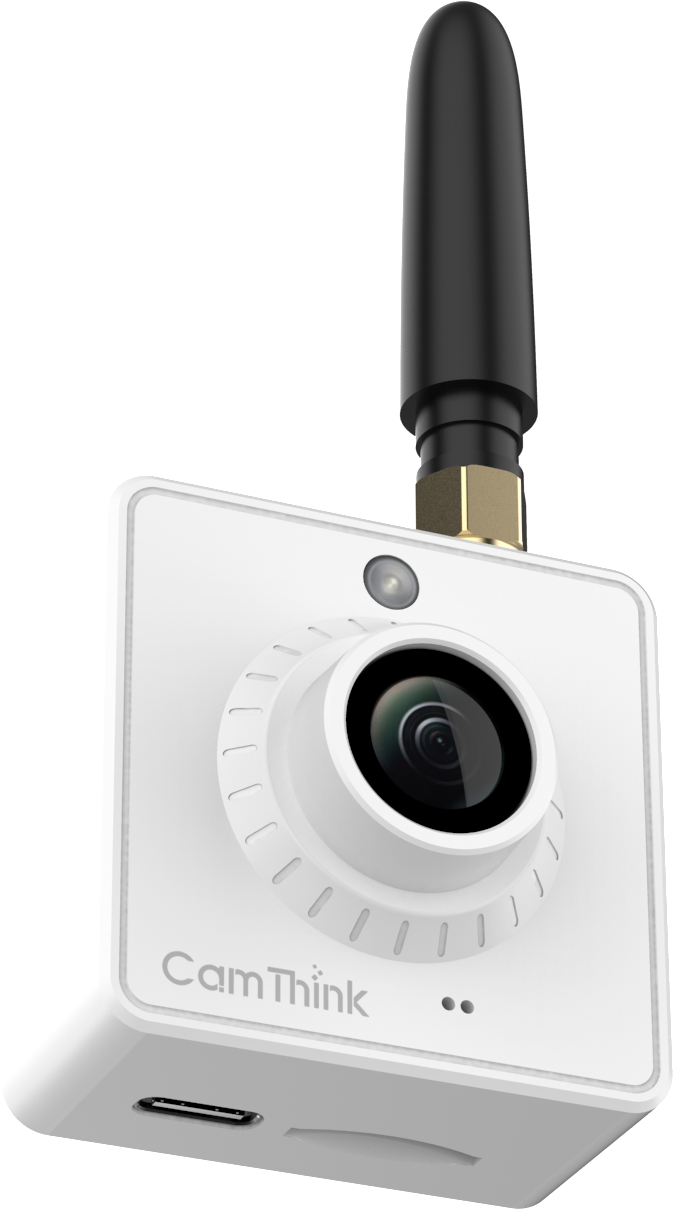
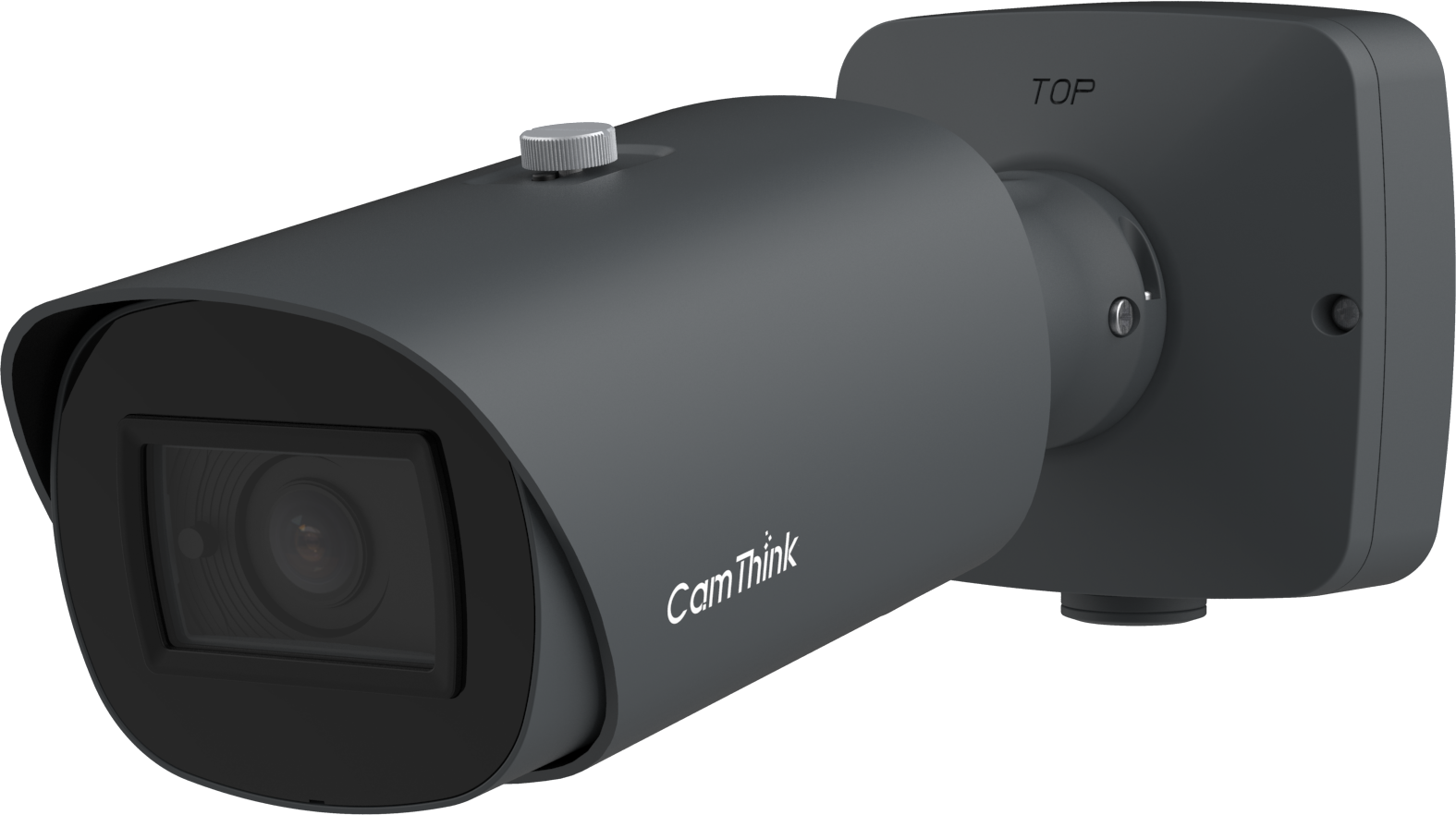
CamThink’s NeoEyes series includes both battery-powered and fixed-power edge AI cameras, designed for different deployment scenarios and operational requirements.
Edge AI Camera vs Standard 4G Security Camera
One of the most common objections buyers have is:
Why not use a standard 4G security camera?
The answer depends on the level of reliability and intelligence required.
Standard 4G Cameras Typically Offer
Motion detection only
Cloud-based notifications
Continuous video uploads
Fixed vendor AI models
Limited API or integration support
These solutions may work for basic monitoring, but they often create false alarms and recurring cloud costs.
Edge AI Cameras Add Operational Intelligence
An edge AI camera can:
Detect real intrusions instead of generic motion
Filter false alarms locally before transmission
Run custom AI models for site-specific rules
Send structured alerts instead of full video streams
Keep sensitive footage on-site for privacy-sensitive projects
Feature
Standard 4G Camera
Edge AI Camera (NE301)
Detection method
PIR or pixel-based motion detection
On-device AI inference (YOLOv8 custom models)
False alarm rate
High — triggered by wind, animals, lighting changes
Low — AI filters before transmission
Data transmission
Continuous video upload or full-frame images
Structured alerts only on confirmed detections
Monthly data usage
5–50 GB (video streaming)
0.5–2 GB (alert images + metadata)
AI customization
Fixed vendor models
Train custom models for your site (workers vs trespassers, authorized vehicles)
Integration options
Vendor cloud only, limited API
Open MQTT API + optional NeoMind platform
Privacy compliance
Footage stored in vendor cloud
On-device processing, transmit only alerts
Battery life (LTE)
Weeks — continuous transmission drains battery
1–2 years with PIR + AI filter
Typical use case
Basic remote monitoring, home/consumer use
Professional security, construction sites, critical infrastructure
Comparison based on typical LTE 4G security cameras vs NE301 in battery + LTE configuration. Actual performance varies by signal strength, detection frequency, and model complexity.
Real-world Example: Construction Site Perimeter
Scenario: Two different events at the same construction site entrance
Event
Standard 4G Camera
Edge AI Camera (NE301)
Worker in hi-vis gear Enters at 2:00 PM (working hours)
Person class: “Worker” → No alert → No action needed
Unknown person Climbs fence at 11:30 PM (after hours)
Motion alert triggered → One of 50+ notifications that shift → May be missed due to alert fatigue
Person class: “Trespasser” + Confidence: 94% → ALERT → Image + metadata sent → Security dispatched
Result per night: Standard 4G = 50+ alerts (mostly false) → Alert fatigue → Real threats missed.
Edge AI = 3–5 actionable alerts → Fast response → Lower monitoring costs.
How Does Edge AI Reduce Construction Site Security Costs?
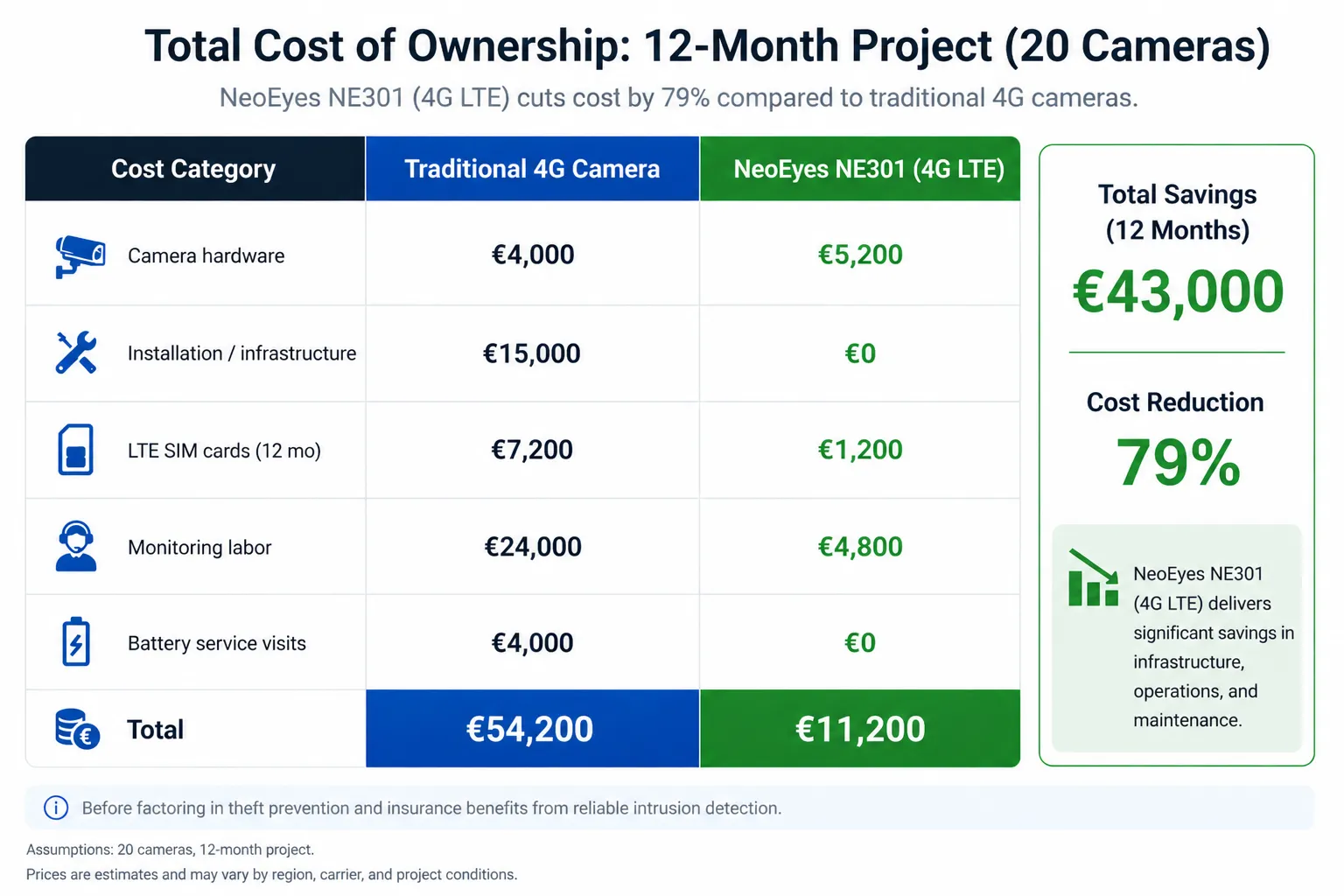
In a 20-camera, 12-month temporary site scenario, a NeoEyes NE301 LTE deployment reduces estimated TCO by 79% compared with traditional 4G cameras.
Lower Infrastructure Costs
Battery + LTE operation eliminates the need for expensive site infrastructure:
No trenching or cabling required
No Ethernet or PoE switch installation
No network infrastructure expansion
Deploy in under 30 minutes per camera
For temporary sites (6–18 months), infrastructure costs often exceed camera hardware costs. Edge AI eliminates this entirely.
Lower Monitoring Costs
False alarms from motion detection create hidden operational costs:
Unnecessary security dispatches
Wasted monitoring labor hours
Alert fatigue → real threats get missed
Reputation damage from repeated false alarms
AI filtering reduces 50+ false alerts/night to 3–5 actionable alerts, cutting monitoring costs by 80–90%.
Lower Cloud and Bandwidth Costs
On-device AI inference means uploading only event-based data, not continuous video:
LTE data usage: 0.5–2 GB/month vs 10–50 GB/month
No cloud AI processing fees — inference runs on-device
Minimal cloud storage — only confirmed detection images
SIM costs drop from €30–150/month to €5–15/month per camera. For a 20-camera site, save €600–2,700/month in data fees.
When Does Edge AI Make Sense for Construction Site Security?
Edge AI cameras provide clear advantages for certain construction site scenarios. Here are five key decision criteria.
High False Alarm Environments
If your current security setup generates 50+ motion alerts per night, edge AI filtering can significantly reduce false alarms when the model is trained for site-specific activity. This translates to 80–90% lower monitoring costs and faster response to real threats. Sites with frequent equipment movement, wind-blown debris, or shifting lighting conditions benefit most.
Sites Without Fixed Power or Internet
Battery + LTE deployment eliminates trenching, cabling, and network infrastructure. Cameras can be mounted and operational in under 30 minutes, making them ideal for temporary sites with no existing utilities. For 6–18 month projects, infrastructure costs often exceed camera hardware costs—edge AI removes this barrier entirely.
Privacy-Sensitive Projects
On-device AI inference keeps raw footage on the device, transmitting only confirmed detections (metadata + single snapshot). This helps support privacy-sensitive deployments and enterprise security policies by reducing the amount of video transmitted off-site. Worker privacy is better protected since faces are not stored or transmitted unless a security event is confirmed.
Sites With High LTE Data Costs
On-device AI reduces unnecessary uploads by 95%, lowering LTE data usage from 10–50 GB/month to 0.5–2 GB/month. This makes edge AI cameras far more cost-effective for multi-camera deployments where LTE bandwidth is limited or expensive.
Custom Detection Requirements
Edge AI cameras can be trained to distinguish site-specific objects that traditional motion detection cannot differentiate: workers in hi-vis gear vs unauthorized trespassers, authorized delivery trucks vs unknown vehicles, scaffold theft vs equipment movement. Custom YOLOv8 models can be deployed in under 2 hours using 100–200 site-specific images.
Choose This
When It Fits
Standard 4G Camera
Basic visibility needed, low alert volume, short-term site, no custom AI requirements
NeoEyes NE301
Battery + LTE for temporary sites (6–18 months): no fixed power, limited bandwidth, high false alarms, privacy concerns
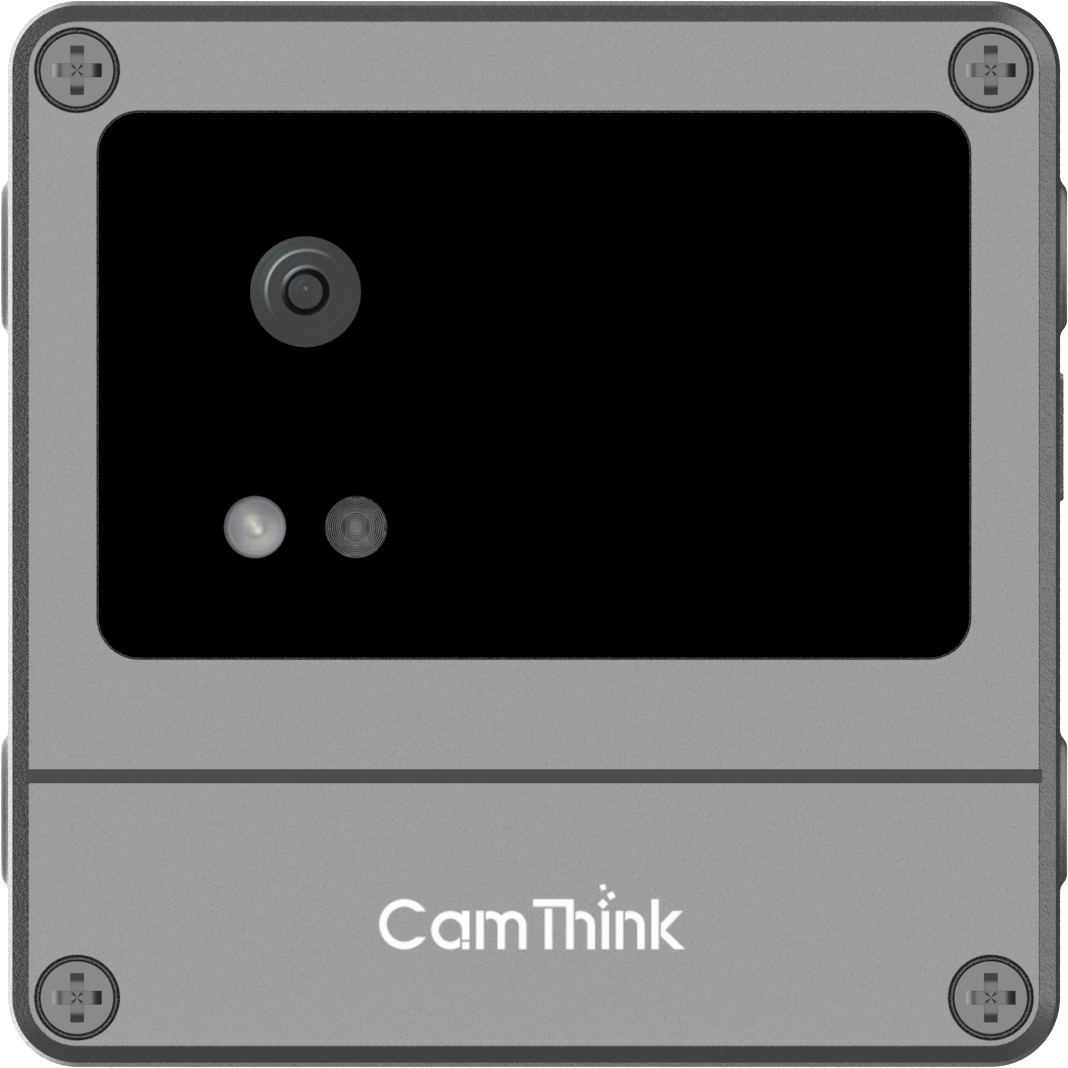
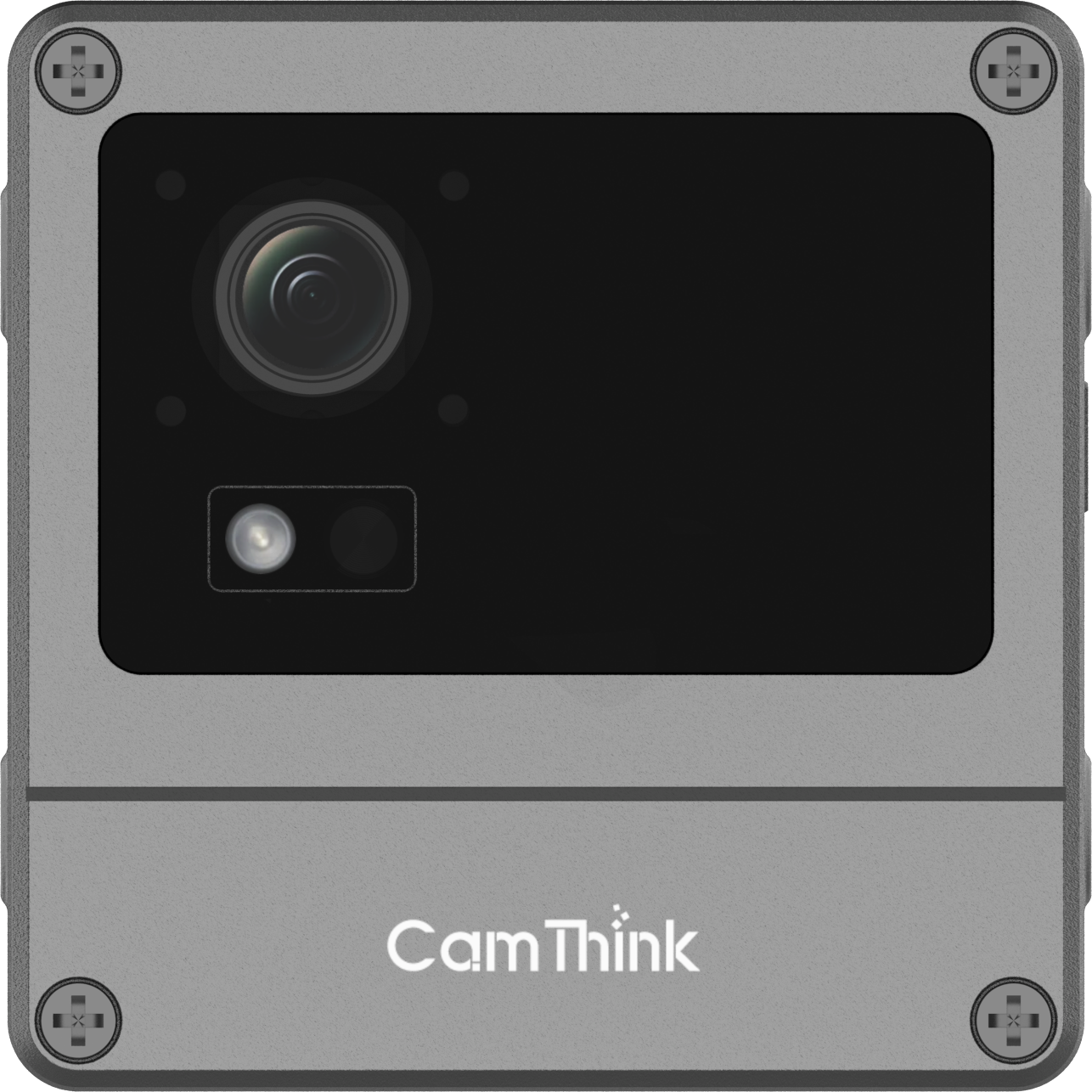
NeoEyes NE503
Fixed Power for permanent sites: stable power available, higher AI compute (20 TOPS) required, 4K evidence, night vision priority
Architecture comparison based on deployment constraints and AI requirements. NE301 serves battery-powered temporary sites; NE503 serves fixed-power sites needing higher compute and night vision. Total cost analysis assumes 12-month project lifecycle.
Which CamThink Hardware Fits Construction Site Security?
CamThink offers two main edge AI camera architectures for construction sites. The right choice depends on your site’s power availability, AI compute requirements, and deployment timeline.
Use case: Perimeter intrusion detection, equipment theft prevention, after-hours security
Best for: Temporary construction sites, remote locations, solar-assisted deployments, and projects where infrastructure costs would exceed hardware costs.
Scenario 2: Fixed-Power Sites with High AI Compute Requirements
Recommended Hardware: NeoEyes NE503
For sites with fixed power that require higher AI compute, better night vision, or multi-model processing, NE503 provides containerized AI capabilities. Key advantages:
AI performance: 20 TOPS compute for multi-stream detection, tracking, and containerized vision-language models
Night vision: Built-in IR illumination for superior low-light performance
Resolution: 4K imaging with detailed capture for evidence documentation
Deployment: PoE or DC power, integrates with existing network infrastructure
Best for: Fixed locations with stable power, high-traffic areas requiring 4K evidence, complex multi-object tracking, or sites transitioning from traditional IP cameras to AI-enhanced surveillance.
Specification
NeoEyes NE301
NeoEyes NE503
Deployment Type
Battery + LTE Cat.1
Fixed Power + PoE
Best For
Temporary sites (6–18 months), no infrastructure
Permanent sites, existing network, high-traffic areas
AI Compute
0.6 TOPS (STM32N6 NPU)
20 TOPS
Design Priority
Ultra-low power for battery operation
Container AI ready, complex multi-object tracking
Not sure which architecture fits? Both platforms support YOLOv8-based models and open firmware, but they serve different operational requirements. Choose NE301 for maximum flexibility in off-grid scenarios, or NE503 when power is available and AI performance is the priority.
NE301 in Action: Real-World Construction Site Deployments
The NeoEyes NE301 has been deployed across diverse construction projects globally. Here are four deployment-style examples that demonstrate its capabilities in battery-powered, edge AI security scenarios.
Battery Life That Matches Project Timelines
Most construction projects last 6–18 months. Traditional solar security cameras require mid-project battery swaps or panel maintenance. The NE301’s 6.1 µA deep sleep mode, combined with PIR-triggered wake-ups and on-device AI filtering, allows it to run 1–2 years on 4× AA batteries at realistic detection frequencies.
For a 12-month highway construction project in the UK, a system integrator deployed 25 NE301 cameras with LTE modules. Each unit was configured for 8–12 PIR-triggered events per day. After 14 months in operation—including a winter with temperatures dropping to −5°C—none of the cameras required battery replacement. The PIR + AI two-stage filter ensured that only human-shaped crossings triggered LTE uploads, while wind-blown debris and animal movement were rejected on-device before consuming power.
Open AI Models Adapt to Site-Specific Threats
Construction sites have unique security challenges: distinguishing between workers in hi-vis gear vs unauthorized trespassers, detecting scaffold theft without triggering on moving equipment, or identifying unknown vehicles in delivery zones. Vendor-locked cloud AI models cannot be retrained for these specific scenarios.
The NE301 runs YOLOv8-based models in TFLite INT8 format, fully compatible with the standard Ultralytics training pipeline. System integrators can collect 100–200 images from the actual site, train a custom model to distinguish site-specific object classes, and deploy it via the Web UI within the same day. A logistics company in the Netherlands used this capability to train their NE301 cameras to recognize three classes: authorized delivery trucks (white-listed by license plate), worker vans (recognized during working hours), and unknown vehicles (alert after hours). This reduced false alarms by 94% compared to their previous motion-triggered 4G cameras.
On-Device Processing Keeps Footage On-Site
GDPR and corporate privacy policies are increasingly strict about where video footage is stored and processed. Many European enterprises prohibit streaming continuous video to cloud servers, especially from temporary work sites where worker privacy cannot be guaranteed.
The NE301’s edge architecture processes all AI inference locally. Only confirmed detections—complete with bounding box, confidence score, and a single JPEG snapshot—are transmitted over LTE. The raw video never leaves the camera. For a German construction firm deploying cameras near residential areas, this meant they could install perimeter monitoring without triggering GDPR data residency concerns. Workers’ faces were never stored or transmitted unless a security event was confirmed by the AI model first.
Rapid Deployment Keeps Pace With Site Changes
Construction sites are dynamic: perimeter fencing moves, equipment zones shift, and temporary offices relocate. Security cameras must be repositioned as the project progresses. Wired infrastructure cannot keep up without expensive re-installation.
A battery + LTE NE301 can be mounted, configured, and operational in under 30 minutes. When a high-rise building project in Singapore entered its foundation phase, the security team moved 12 cameras from the initial excavation perimeter to the newly poured basement walls in a single day. No trenching, no PoE switches, no WiFi extensions—just re-mount the IP67 enclosures, verify LTE signal, and the cameras resumed monitoring with their existing AI models and MQTT alert rules intact.
Real deployment scenarios
The NE301 is currently deployed for perimeter intrusion detection on highway construction sites, equipment theft prevention at renewable energy installations, and after-hours security at urban redevelopment projects. What these sites have in common: no fixed power, no existing network infrastructure, and a need for reliable detection without constant human monitoring.
Keep Construction Site Video Private With On-Device AI
On-device AI inference keeps construction site video private by processing all footage locally and transmitting only confirmed detections—supporting privacy-sensitive deployments by reducing the amount of video transmitted off-site.
Cloud-based surveillance often creates concerns around:
GDPR
Worker privacy
Internal security policies
On-Device AI Inference = Privacy by Design
With on-device AI inference, video does not need to be streamed continuously. You can send only metadata, alerts, and snapshots. This keeps sensitive footage on-site or within the customer’s own system.
For privacy-sensitive deployments, this is often a deciding factor. If you’re evaluating edge AI for your construction site, we can review your requirements and provide a customized hardware BOM.
Which Security Architecture Fits Your Construction Site?
Choosing between standard 4G cameras and edge AI systems depends on your site’s power availability, alert volume, and privacy requirements. For temporary sites without fixed infrastructure, battery-powered edge AI cameras like the NeoEyes NE301 reduce total cost of ownership by 79% over 12-month projects. For fixed-power locations requiring higher AI compute and better night vision, containerized AI cameras like the NeoEyes NE503 provide higher compute headroom for real-time multi-model inference and 4K video analytics.
For System Integrators and Construction Site Operators
Both NE301 and NE503 support YOLOv8-based models and open firmware, giving you flexibility to customize detection rules for your specific site requirements. NE301 maximizes deployment flexibility for off-grid scenarios, while NE503 delivers higher performance when infrastructure is available.
Frequently Asked Questions
How long can a battery-powered construction site camera run?
Battery life depends on event frequency, connectivity mode, and temperature. With event-triggered LTE capture, devices can run for months to over one year.
Can it work without WiFi?
Yes. LTE allows deployment in remote or temporary locations without local internet.
Can it integrate with existing alarm systems?
Yes. Most deployments use MQTT, HTTP, or Webhooks for integration with alarm platforms and VMS.
Can the AI model be customized?
Yes. Custom models can be deployed for specific detection requirements, such as distinguishing workers from intruders or recognizing authorized vehicles.
Is it suitable for night monitoring?
Yes, NE503 includes built-in IR for night monitoring, while NE301 performs best with ambient light or external illumination.
HH
Harry Hua
Technical Director, CamThink · Edge AI & IoT Security Systems
Harry leads CamThink’s technical direction across hardware, firmware, and edge AI deployment.
He has worked across security system integration, industrial IoT, and smart agriculture projects
spanning Europe and Asia-Pacific.