IoT Camera Meter Reading: Non-Invasive Legacy Meter Digitization With Edge AI — No Replacement Required
Water, gas, and industrial meters can be read remotely without touching the meter — by mounting a low-power IoT
camera in front of the dial. NE101 can send scheduled images directly to your system; when numeric readings are
needed, NeoMind’s OCR extension can run on an NG4500 or suitable PC/Linux host and deliver the result to your
SCADA or BMS without a cloud dependency when deployed on-site.
⏱ ~10 min read📅 Updated 2026📍 NeoEyes NE101 · NeoMind · NG4500⚡ Intermediate · System Integrators
~40%
Water lost or unaccounted for in emerging and developing countries due to leaks, theft,
and meter inaccuracies (World Bank)
2–3 yr
Estimated NE101 battery life at low capture rates
OCR
NeoMind OCR extension runs on NG4500 or a suitable host
$69.90
Starting price for NeoEyes NE101, per unit — fully assembled with open firmware
Is This the Right Solution for Your Project?
Most legacy water, gas, and industrial meters have no data port, no pulse output, and no wireless interface. They
were designed to be read by a person standing in front of them. Replacing them with smart meters solves the data
problem — but at a cost that is often prohibitive at scale: each meter swap requires service interruption,
possible regulatory sign-off, and hardware costs of $150–300+ per unit. For a facility manager with 200
sub-meters, or a utility running tens of thousands of meters in the field, full replacement is a multi-year
capital project, not a quick integration task.
The camera-based approach addresses this differently: the mechanical meter stays in place and continues operating
normally. A compact, battery-powered imaging camera is mounted in front of the dial face. It captures a photo on a
configured schedule, and transmits the image to your system. If you need a numerical reading rather than the
photo itself, NeoMind can run OCR on a host and forward the result to your data system. No pipework. No service
interruption. No meter certification re-process.
NE101 handles image capture and transmission on its own. When a project needs automatic digit recognition, the
OCR function can be added on a separate host. This guide covers both routes: direct image delivery and NeoMind
OCR on an NG4500 or suitable PC/Linux host, which can run on-site without a third-party cloud.
💡
Architecture Principle
The NE101’s job is clear: capture a sharp image and deliver it reliably to the destination you choose.
Image-only projects can stop there. When you need digit recognition, NeoMind adds a separate OCR layer that
can be updated without changing the camera installation.
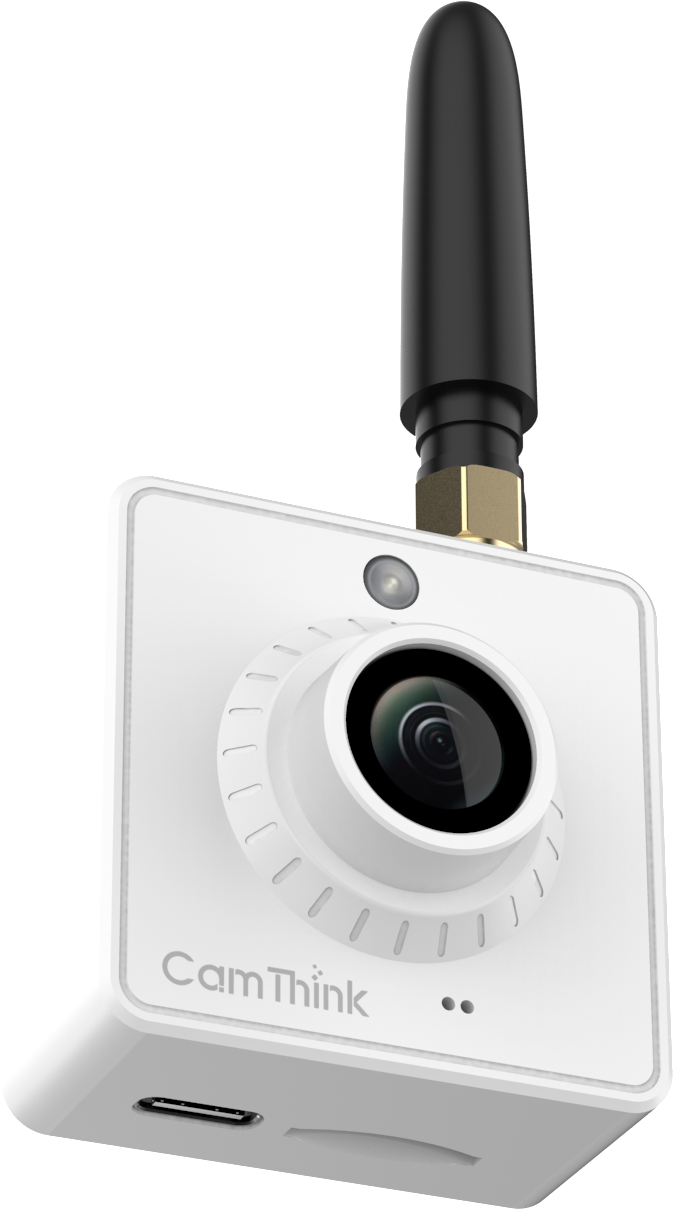
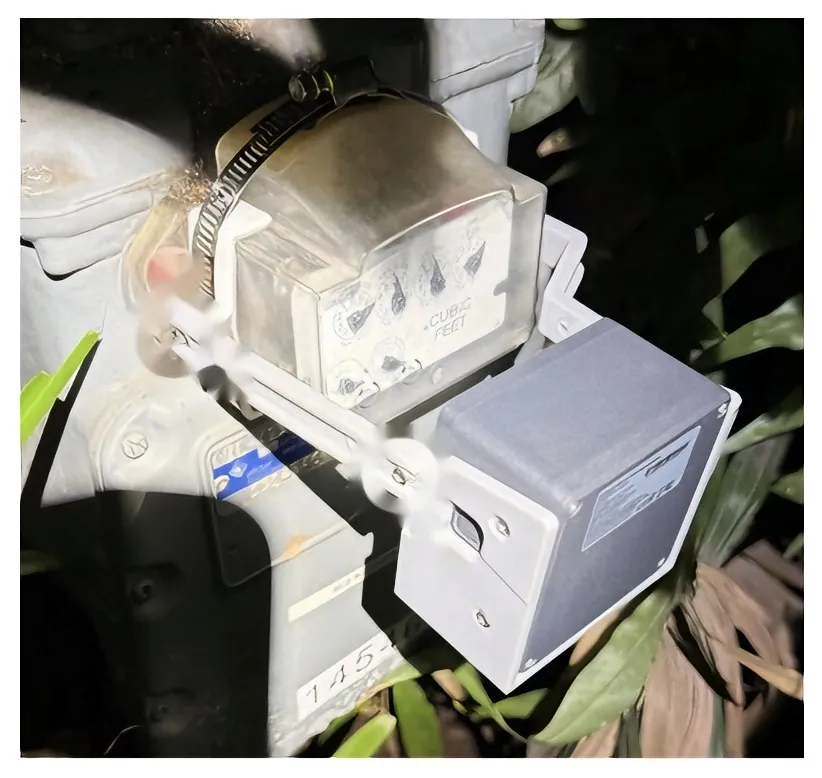
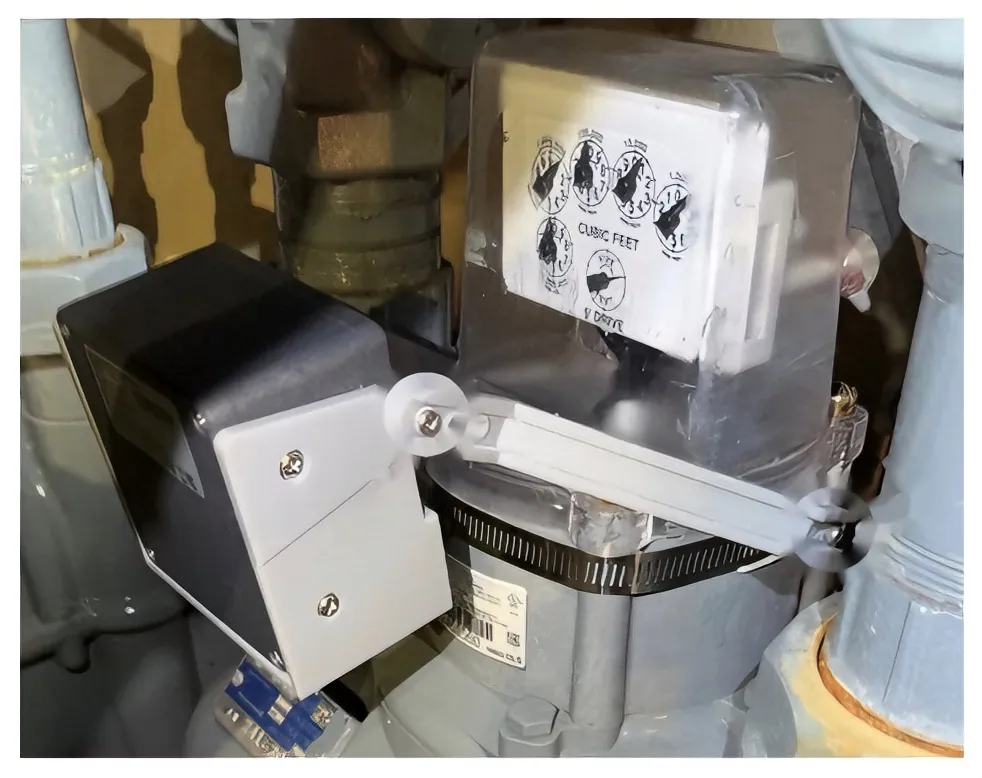
NeoEyes NE101 — compact form factor designed for tight meter enclosures
Typical deployment scenario: underground water meter pit, battery-powered camera with
LTE uplink
System Architecture: How Capture, Inference, and Delivery Work Together
A camera-based meter reading system starts with capture and image delivery. The OCR and structured-data steps
below apply when your project needs automatic readings rather than the photos alone.
1
Trigger — NE101
The NE101 wakes from deep sleep on a time schedule (e.g., every 4–6 hours) or on an external signal (reed
switch, PIR, or MQTT command). Scheduled low-frequency capture can support multi-year battery operation;
size the battery for the actual capture frequency and network conditions.
2
Capture — NE101
The 5MP OV5640 sensor captures a full-resolution image of the meter face. Lens selection matters: a
narrow-FOV module (≈60°) suits close-mounted meters; a wider module (≈120°) works where there’s more
stand-off distance. The NE101’s modular lens design allows field swaps without depot return.
3
Transmit — NE101
The image is compressed and pushed over Wi-Fi 4, or — for meters without reliable WiFi coverage (basements,
outdoor pits, remote sites) — optional LTE Cat.1 or WiFi HaLow. Upload time depends on image size and link
quality, after which the device returns to deep sleep.
4
Digit Recognition — NeoMind OCR
For automatic numerical readings, configure NE101 to publish images to the MQTT broker used by NeoMind on a
NeoEdge NG4500 or suitable PC/Linux host.
NeoMind’s OCR extension extracts the reading and can run on-premise without a third-party cloud service.
If you only need photos, the same NE101 reporting settings can target a reachable broker in your own
system or cloud; no OCR host is needed.
5
Deliver to Your System — Image or Reading
For image-only use, NE101 can publish via MQTT (a lightweight IoT pub/sub messaging
protocol) to a broker used by your system or cloud, without NeoMind. If OCR is required, NE101 sends the
image to NeoMind’s configured broker; after recognition and validation, NeoMind delivers the structured
reading to SCADA, BMS, or a
dashboard through OpenAPI, Data Push, or Webhook integration — see the CamThink
Wiki for device-side MQTT reporting.
💡
Where OCR Runs
NE101 can deliver meter images directly to your MQTT broker when no OCR is needed. For automated readings,
NeoMind handles OCR and data aggregation on an NG4500 or suitable PC/Linux host.
💡
A Realistic Note on OCR Accuracy
OCR recognition accuracy depends on three factors you control: image sharpness (lens alignment, standoff
distance), lighting conditions (the NE101 has a built-in fill light configurable for automatic, scheduled, or
always-on modes), and model quality. On clean, high-contrast mechanical meter faces under consistent lighting,
a validated digit recognition model can achieve high read accuracy. On worn, reflective, or
partially obscured dials, accuracy drops and supplemental lighting or a custom-trained model is needed.
CamThink’s algorithm customisation service can train and validate a model specifically for your meter type —
contact us if you need a turnkey inference layer rather than building it yourself.
🔧
How quickly can you get from unboxing to a first test image?
For the NE101 hardware side: install batteries, connect to the device’s built-in Wi-Fi AP (SSID:
NE101_XXXXXX, no password), open 192.168.1.1 in a browser, configure your MQTT broker address and capture
schedule — typically under 15 minutes. The first test image uploads immediately on button press. The OCR layer
(extracting the numeric value from the image) is separate: if you are connecting to an existing server-side
OCR pipeline, add-on time depends on the integration. For a new deployment, install NeoMind and its OCR
extension on the host, then validate readings against your own meter images. See the NE101 Quick Start guide for the device
setup flow.
🔧
Developer Note: NE101 firmware and NeoMind OCR
The NE101 ships with pre-built open-source firmware including MQTT and HTTP support — no custom firmware
needed for day-one image upload. Trigger logic, image compression, and wake schedule are configurable via Web
UI or the open SDK. On the NeoMind host, install the paddle-ocr-v6 OCR extension and connect the camera’s
image reports to the platform. The NeoMind
OCR use case documents the image-ingestion and recognition workflow. If your meter faces need a
customised model, validate it with representative images before deployment.
DIY Camera Build vs. Packaged Hardware: What the Tradeoffs Look Like at Scale
A bare ESP32-S3 camera board can capture images and upload them over WiFi — the core function is achievable with
commodity hardware. The practical question for any integrator deploying across 10, 50, or 200+ meter points is not
whether it’s technically possible, but what the total cost looks like when you factor in enclosure engineering,
field failure rate, battery longevity, and ongoing maintenance overhead.
Dimension
DIY ESP32 Camera Build
NeoEyes NE101
Time to first image
Hours to days (PCB assembly, firmware flash, case fabrication)
Minutes (pre-flashed firmware, Web UI configuration)
Weather protection
DIY enclosure — waterproofing quality varies
IP67-rated — dust-tight, built for -20°C to 50°C
environments
Battery life
Weeks to months depending on hardware selection and sleep configuration
2–3 years estimated at low capture rates; use the battery calculator for your schedule and network mode
Connectivity options
WiFi (typically); LTE or sub-GHz requires additional module work
Fixed to chosen module; lens swap requires new hardware
Modular, interchangeable lenses — 3D-printable mounts available
Scale management
No fleet management — each unit configured manually
Compatible with NeoMind edge AI platform for device fleet management
Hardware cost (per unit)
$20–60 (BOM only; excludes engineering time, enclosure, accessories)
$69.90–$112.00 — fully assembled with accessories
Open source / hackable
Fully open
Open SDK + GitHub — firmware is modifiable
The DIY path is not wrong — it is a legitimate starting point for developers learning the stack or validating a
concept for a single site. The packaged hardware path becomes more cost-effective once you account for engineering
hours, enclosure sourcing, and the ongoing cost of a component that fails in the field because moisture got in. At
10+ units, the per-unit cost delta typically inverts.
📌
Choose the Capture Node for the Job
NE101 can deliver meter photos directly to your system, whether you have a handful of points
or a larger fleet. Add NeoMind when numerical readings are needed. NE301 is an option when
the application also calls for its supported on-device vision functions; meter-reading OCR can use the same
NeoMind host workflow after validating the camera’s reporting path.
Connectivity, Power, and Lighting: Deploying Where Infrastructure Is Limited
The majority of legacy meters are not in server rooms. They are in basement utility closets with no power outlet,
in outdoor street-side cabinets, in underground pits, and at agricultural pump stations kilometres from the
nearest router. Any camera-based solution that requires mains power or reliable WiFi coverage will fail on this
hardware before it starts.
Battery sizing for multi-year operation
In scheduled mode, the NE101 wakes, captures, transmits, and returns to deep sleep. The 0.8 W standby
figure in the product overview describes a PIR/radar outdoor-monitoring example, not the battery budget for
scheduled meter reads. At a capture frequency of once every 4–6 hours (4–6 reads per day), multi-year operation
is possible under suitable conditions. Use the CamThink Battery Life Calculator
for the selected battery, network mode, and capture schedule; actual life also depends on signal quality,
temperature, and image upload time.
LTE Cat.1 for locations without WiFi
The NE101’s modular communication design supports an optional LTE Cat.1 module. LTE Cat.1 provides adequate
throughput for image upload, with payload size depending on image settings. It operates on existing 4G
infrastructure. For meters in outdoor utility cabinets
or rural water supply networks with cellular coverage, LTE Cat.1 removes the WiFi dependency entirely.
Built-in fill light for dark enclosures
The NE101 includes a built-in fill light controllable directly from the Web UI — no external LED or GPIO wiring
required. Four modes are available: automatic (light activates when ambient lux falls below a configurable
threshold), scheduled (active only during a defined time window), always-on, and always-off. For underground meter
pits or enclosed cabinets with no ambient light, automatic mode with a low lux threshold is a practical
configuration: the light fires in sync with each capture event and shuts off immediately after. Include its
energy use in the per-capture battery budget. Light intensity is adjustable from 1 to 100. Full configuration
walkthrough is in the NE101 Quick
Start guide.
WiFi HaLow for long-range or through-wall installations
For sites where cellular is unavailable or cost-prohibitive but WiFi range is the limiting factor, the NE101 also
supports an optional WiFi HaLow (802.11ah) module. WiFi HaLow operates in the sub-GHz band,
giving it significantly better wall and concrete penetration than standard 2.4 GHz WiFi — making it well suited
for basement meter rooms, dense building infrastructure, and campus-scale utility networks where a HaLow
access point can serve multiple meters within its tested coverage. Unlike cellular, HaLow operates on private infrastructure with no SIM
card or recurring data cost.
💡
Three Wireless Paths, One Modular Platform
Underground meter pits and dense building environments often combine two constraints: no standard WiFi
penetration and no power outlet. The NE101 addresses this with three field-swappable communication modules:
LTE Cat.1 for cellular coverage, WiFi HaLow (802.11ah, sub-GHz) for
long-range through-wall coverage on private infrastructure, and standard WiFi 4 for connected
indoor environments. Battery operation + IP67 casing handles the power and weatherproofing side.
Water Meter, Gas Meter, and Industrial Gauge Reading: What Works and What Doesn’t
The NE101 is a general-purpose imaging device — it captures whatever is in front of the lens. The constraint is
optical, not functional: the meter face must be legible in the image, which means adequate lighting, minimal
reflective glare, and sufficient resolution to distinguish individual digits.
Water meters
Mechanical totalizing water meters (drum counters, odometer-style readouts) are the most straightforward case. The
digit window is typically high-contrast, printed on a light background, and does not change orientation. Standard
OCR models trained on digit sequences handle these reliably. Wet-dial meters (where the counter is submerged under
a glass cover) may require a supplemental LED ring light in low-ambient-light pits — this can be triggered in sync
with the camera’s capture event.
Gas meters
Residential and commercial gas meters with dial-type or digital readout windows are also within scope. Dial meters
(pointer-on-numbered-dial format) require a slightly different OCR model than digit-window meters — dial position
inference rather than character recognition. This is a solvable problem but does add model complexity on the
server side.
Industrial gauges and pressure meters
Pressure gauges, flow meters, and other analogue industrial instruments with circular dial faces can be read with
pointer-detection models. The NE101 has been deployed in machine malfunction monitoring contexts where similar
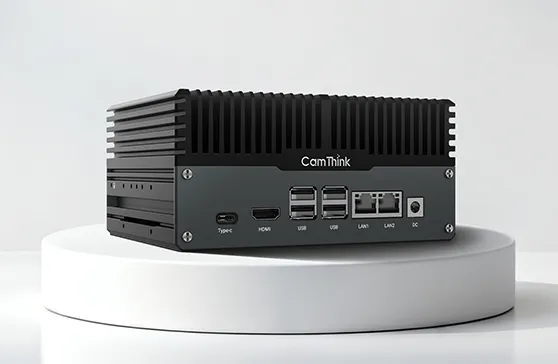
visual inspection logic applies. For complex multi-variable panels, the NeoEdge NG4500 provides
the compute headroom to run heavier vision models locally.
Meters that require a different approach
Fully electronic meters with backlit LCD displays in direct sunlight environments can produce overexposed images
that challenge OCR. Meters in deep pits with no ambient light require supplemental illumination. Meters where the
dial face is not physically accessible for camera mounting are better served by pulse-output pulse counters or
RS485 output modules — camera-based reading is not universally applicable.
Connecting Meter Images or Readings to Your System
If your system needs photos rather than extracted readings, point the NE101 at your reachable MQTT broker, whether
it is on-site or in your cloud, and consume the image reports directly; NeoMind and an OCR host are optional.
When numerical data is needed, MQTT carries the
image to NeoMind, which runs OCR and delivers the processed reading to SCADA, BMS, or building automation systems
through OpenAPI, Data Push, or Webhook.
How image upload and reading delivery work
In the OCR workflow, each capture event publishes an image and device metadata to NeoMind’s configured MQTT broker.
The camera payload does not contain the OCR value. NeoMind performs recognition and validation, then exposes a
structured reading and photo evidence to your business system. The JSON below illustrates a downstream record
after OCR; it is not the raw camera MQTT payload.
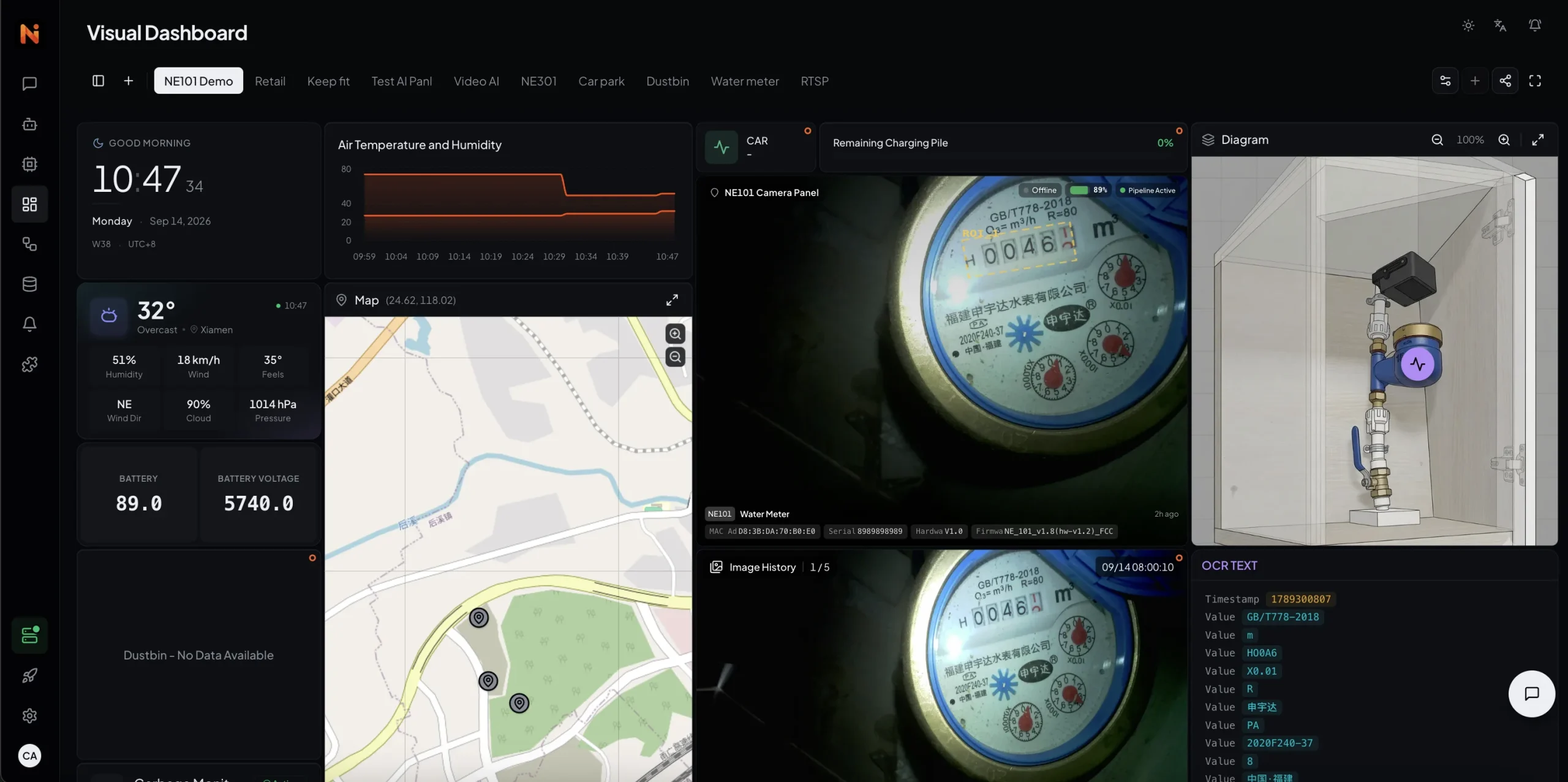
NeoMind dashboard example: water-meter capture, image history, and OCR text in one view. Source: CamThink Wiki.
Device-side MQTT reporting and NeoMind’s camera/OCR workflow are documented in the CamThink Wiki. Configure the camera to reach the NeoMind host, then map the processed reading to the fields required by your system.
📌
Fully On-Premise When Hosted Locally
With an on-site NeoMind host and no cloud forwarding, image capture, digit recognition, and data delivery
can stay on your own network. NE101 captures and transmits; NeoMind on a NeoEdge NG4500 or suitable PC/Linux host runs the OCR extension; your SCADA or BMS receives the structured reading through the configured integration.
Hardware Selection: Matching Product to Deployment Architecture
The right hardware depends on what you need from the image: a photo in your own system, or an automatic reading.
The cards below show where each CamThink product fits.
Event-triggered and scheduled capture · low-power sleep
Multi-year battery estimates at low capture rates
Open firmware · MQTT / HTTP · Web UI
Use when:
You need scheduled meter photos delivered to your own system, from a few points to a large fleet. If you
also need numerical readings, send those images to NeoMind for OCR on an NG4500 or suitable host.
Use when:
Your application also needs NE301’s supported on-device vision functions. For numerical meter readings,
its images can follow the NeoMind OCR workflow on an NG4500 or suitable PC/Linux host.
Pairs with capture nodes
for multi-camera deployments
NVIDIA Jetson Orin NX / Nano
Up to 157 TOPS compute
Aggregates camera image feeds
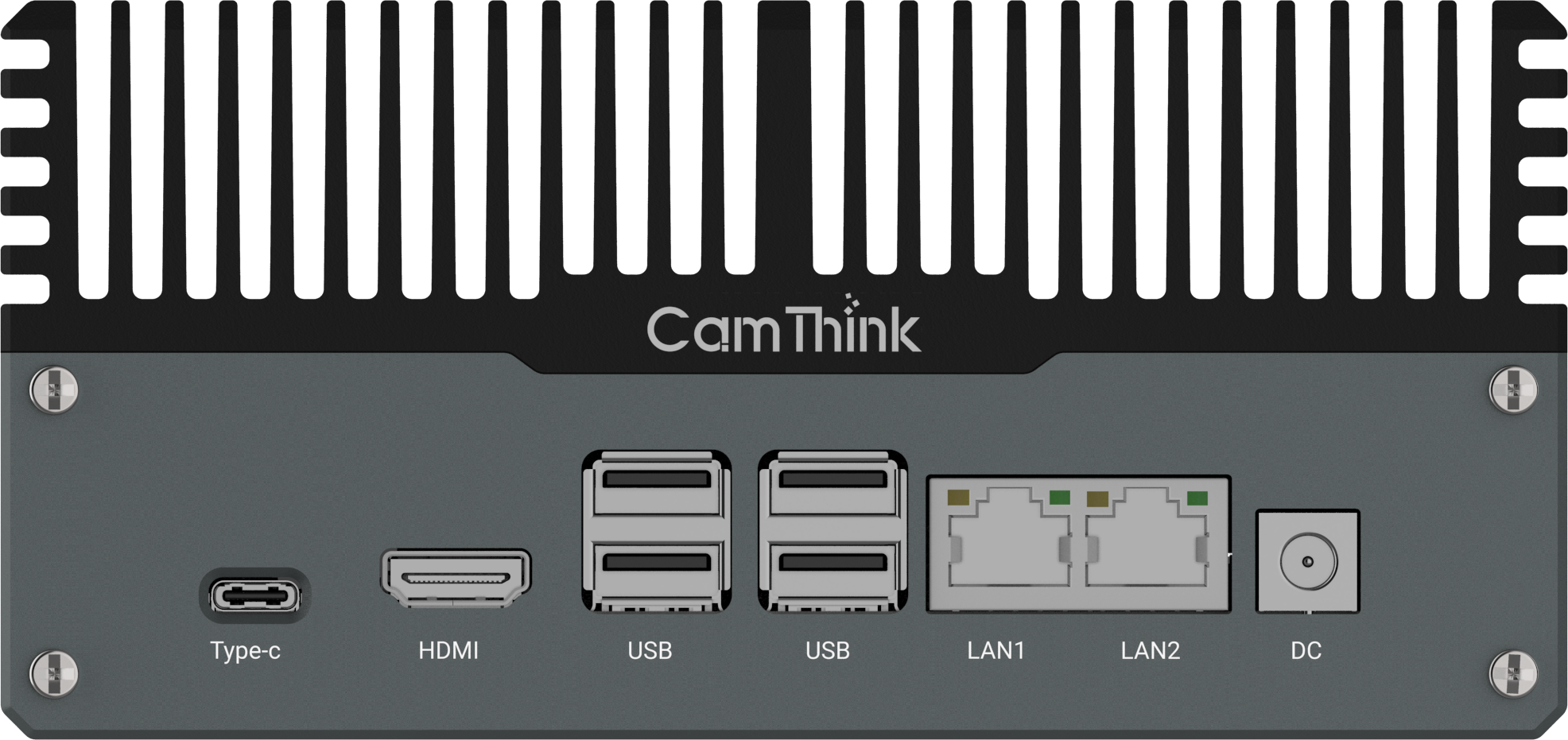
Runs NeoMind OCR extension on-premise
JetPack 6.0+ · fanless · 12–36V DC
MQTT image ingest · API / Data Push / Webhook
Use when:
You need centralised digit recognition for multiple camera units. NeoMind ingests images,
runs the OCR extension, validates readings, and sends structured data to business systems.
Does the NE101 extract meter readings on the device, or does it just capture images?
The NE101 captures and transmits images. If photos meet your needs, send them straight to the MQTT broker
used by your system; you do not need NeoMind or an NG4500. If you need numerical readings, NeoMind’s OCR
extension runs on an NG4500 or suitable PC/Linux host and turns those images into structured data.
How is the camera physically mounted next to a meter?
The NE101 uses a modular mounting system with optional brackets available in the CamThink store. 3D-printable
mount files are published on the CamThink Wiki for custom enclosure and bracket designs. The camera body is 77
× 77 × 48 mm — compact enough to fit in standard meter cabinets and pit enclosures. Clamp-style and
adhesive-plate configurations are both documented.
What happens if the WiFi signal is unavailable at the meter location?
The NE101 supports two connectivity modules beyond standard WiFi 4. LTE Cat.1 connects via
cellular 4G — suitable for outdoor and remote sites with mobile coverage and no private network
infrastructure. WiFi HaLow (802.11ah) is a sub-GHz WiFi standard that penetrates concrete
walls and floors far more effectively than 2.4 GHz WiFi, making it better suited for basement meter rooms and
multi-floor building deployments on private infrastructure (no SIM, no recurring cellular cost). Both modules
are field-swappable without depot return.
Can the NE101 work in a completely dark underground pit?
Yes — the NE101 has a built-in fill light that you configure directly in the Web UI, no external wiring or
GPIO setup required. For fully dark enclosures, set fill light to automatic mode with a low lux threshold: the
light fires only during each capture event and turns off immediately after; include its use in the
battery calculation. Intensity is adjustable from 1–100. This is the standard setup for underground meter pit
deployments.
What OCR or digit recognition approach does CamThink recommend?
Recognition accuracy depends on the meter face condition, lighting, and model quality — not the camera
hardware alone. On clean, high-contrast mechanical dials with consistent lighting, a well-trained model
can achieve high accuracy after validation. On worn or reflective surfaces, a custom-trained model is usually
necessary. CamThink’s meter-reading path runs the NeoMind OCR extension on an NG4500 or suitable PC/Linux
host. For teams without an in-house AI capability, CamThink’s
algorithm customisation service can help validate the workflow against your meter images. Contact us with
your meter type and volume to get a scoping estimate.
Is the meter reading data stored on the device?
The NE101 has a Micro TF card slot for local image storage. Whether images are uploaded after connectivity
returns depends on the configured workflow; do not treat the card as an automatic store-and-forward guarantee.
For compliance or audit applications requiring long-term local retention, discuss your requirements via the
CamThink contact form.
How many NE101 units can be managed centrally?
Individual NE101 units are configured via a browser-based Web UI or MQTT commands. For fleet-scale deployments
(50+ units), NeoMind can centralise image intake, OCR, and deployment monitoring. The standard NE101 firmware
upgrade path is its Web UI; remote fleet updates require a separate OTA integration. Contact CamThink for
NeoMind access and pricing.
Have a Meter Digitization Project in Mind?
Tell us the meter type, site count, and connectivity constraints — we’ll help you identify the right hardware
configuration and integration path before you commit to volume.