Quick answer
Use an edge AI box when the site already has useful IP cameras and the project needs centralized local inference without replacing those cameras. The box sits on the same site network, consumes camera streams such as RTSP, runs AI workloads locally, and sends events, clips or metadata to the VMS, MQTT broker, REST service or operations platform.
This is not the same decision as adding a new AI IPC. An edge AI box is a better first path when many existing cameras already cover the scene, the team wants to preserve VMS recording workflows, and the AI workload benefits from a shared compute node. A new AI camera is a better first path when a specific point needs its own image capture, local decision logic and field I/O.
For installed CCTV upgrades, the edge AI box path answers one question: how do we add AI behind existing cameras without moving the camera layer?
When this path fits
The edge AI box path fits best when the cameras are already in the right places. If a camera has the needed view, lighting, focus and resolution, replacing it only to add AI may create unnecessary installation work. A local edge box lets the AI layer be added beside the existing VMS and network architecture.
Typical signs that this path is worth evaluating:
- The site already has several IP cameras with stable streams and acceptable image quality.
- The customer wants AI events, but still wants the VMS or NVR to own live view, recording and operator review.
- The AI task may require a larger model, multiple model stages or more compute than a small on-camera processor can provide.
- The deployment team wants to manage model versions and event routing from one local node instead of updating many cameras.
- The site prefers local processing before sending selected results to cloud or business systems.
Reference architecture
A typical installed-camera AI upgrade has five layers. The edge AI box does not replace every layer. It adds the local compute and event layer between camera capture and operations software.
CamerasInstalled IPCs with usable view, lighting and stream access.
NetworkSwitches, VLANs, bandwidth and security rules for stream access.
Edge AI boxLocal compute for decoding, inference, post-processing and event shaping.
Event pathMQTT, REST, Webhook, VMS connector or middleware.
OperationsVMS, dashboard, alarm workflow, reporting or business system.
In this architecture, the VMS can continue to provide video review while the edge AI box produces structured events. That separation matters. Operators still see familiar camera names and recordings, while the AI service adds detections, rules, filtering or alerts.
Where NG4500 fits
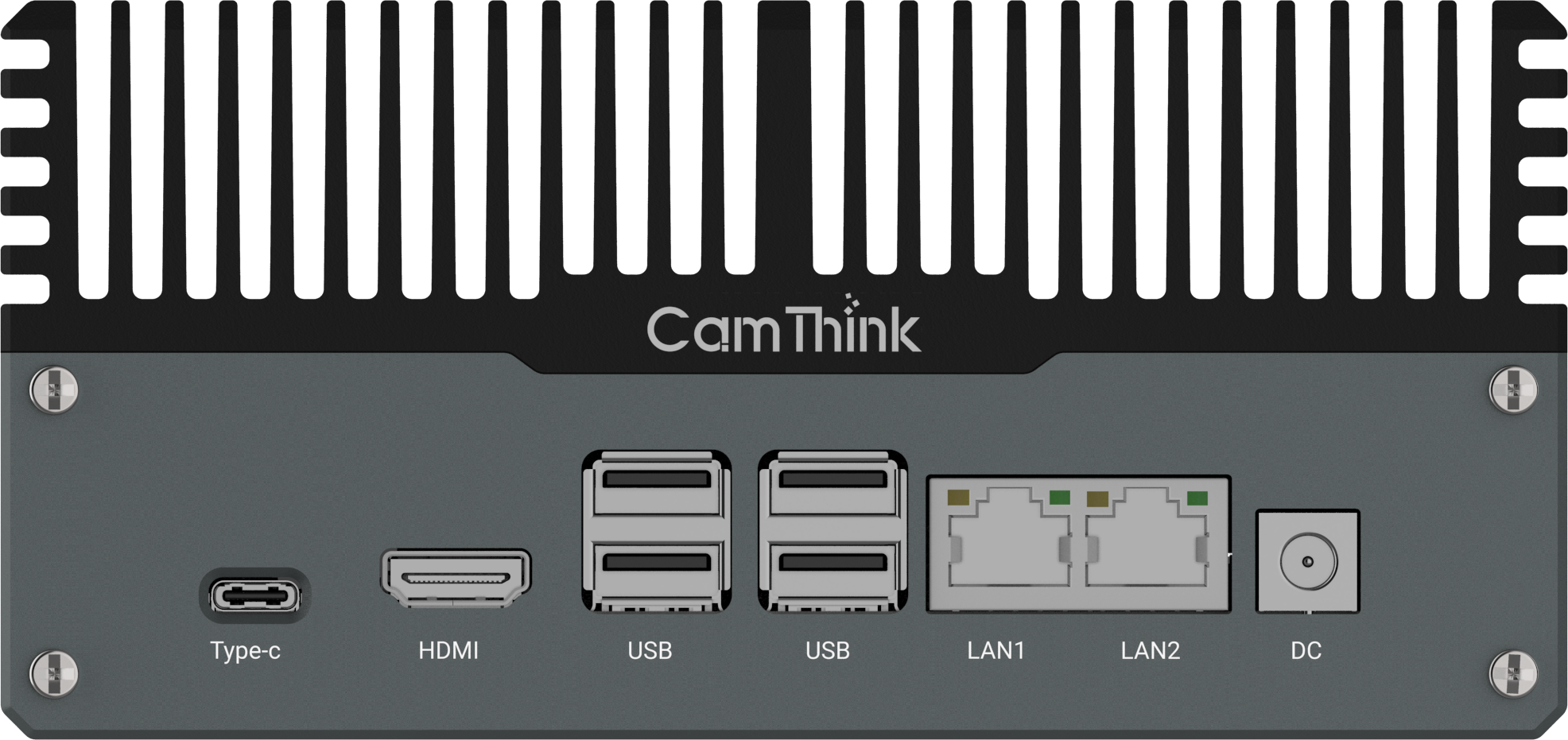
NeoEdge NG4500 fits this path as a Jetson Orin Nano/NX edge AI gateway for high-compute visual AI workloads. It is designed for local AI gateway roles where the system needs GPU-accelerated inference, industrial I/O and support for common edge AI software stacks.
Compute platformJetson Orin Nano 4GB/8GB or Orin NX 8GB/16GB modules.
AI performance range20-100 TOPS standard, with 34-157 TOPS INT8 Super mode depending on module and mode.
Network and I/O2x Gigabit Ethernet, USB 3.1, USB-C, HDMI, audio, RS232, RS485, CAN and DI/DO.
Software stackJetPack 6.0+, CUDA, TensorRT, DeepStream, PyTorch, ONNX, TensorFlow and related AI runtimes.
ExpansionDual M.2 Key M NVMe, M.2 Key B for 4G/5G, M.2 Key E for Wi-Fi/Bluetooth and Nano SIM.
Deployment12-36 V DC, fanless enclosure, desktop, wall or DIN rail mounting, -25°C to 60°C environment rating.
Those facts make NG4500 a strong candidate when the AI layer needs Jetson-class compute, local model execution, stream processing frameworks or industrial connectivity. They do not remove the need for site validation. Camera count, resolution, frame rate, codec, model type, preprocessing and event logic all affect the final workload.
Important boundary: do not turn a product specification into a stream-count promise. Validate the exact cameras, streams, models and event outputs in the customer’s environment before committing to rollout.
What to inventory before sizing
Before selecting an edge AI box, collect the camera and workload facts. This prevents the project from being sized around a rough camera count instead of the actual data path.
| Inventory item | Why it matters | What to record |
|---|
| Camera stream | Decode and ingest load depends on codec, resolution, frame rate and stream stability. | RTSP URL, codec, resolution, FPS, bitrate, keyframe interval and whether sub-streams are available. |
| Scene quality | AI accuracy depends on viewpoint, lighting, blur, occlusion and object size. | Sample clips for day, night, peak activity, bad weather or low-light conditions. |
| AI task | Person detection, vehicle detection, PPE, intrusion, ANPR and VLM-style analysis have different model costs. | Target classes, rules, confidence thresholds, zones, tracking and expected event rate. |
| Output system | The receiving system determines event format and integration complexity. | VMS event path, MQTT broker, REST endpoint, Webhook, dashboard or custom middleware. |
| Network and security | Stream access may be blocked by VLANs, credentials or bandwidth limits. | Switch location, VLAN rules, camera credentials, firewall policy and remote maintenance path. |
| Installation conditions | Edge boxes still need power, mounting, cooling and maintenance access. | Cabinet space, 12-36 V DC power, DIN rail or wall mount, ambient temperature and service window. |
Common deployment patterns
VMS-adjacent AI events
The VMS remains the operator’s video system. The edge AI box reads selected camera streams, runs detection and forwards events to middleware or a VMS-compatible event path. This pattern is useful when the customer trusts the existing VMS for recording but wants better event filtering.
Site-local AI gateway
The edge AI box becomes the local gateway for one site. It may run multiple models, normalize event payloads, buffer events during network interruptions and send selected results to cloud or enterprise software. This pattern fits distributed sites where raw video should not always leave the premises.
Industrial I/O bridge
Some projects connect visual AI to field systems. NG4500 provides interfaces such as RS232, RS485, CAN and DI/DO, which can support integration discussions with industrial equipment, alarms or local controllers. The application logic and protocol bridge still need to be designed for the specific deployment.
If your project already has target camera streams and a receiving platform, ask CamThink to review the NG4500 evaluation path.
When not to use an edge AI box first
An edge AI box is not the default answer for every camera project. It is strongest when existing cameras should be preserved. If the project lacks a suitable camera at the point of interest, adding compute behind the wrong view will not fix the image problem.
- Use an AI IPC path when a new gate, lane, access point or machine-side point needs its own camera, model and local action.
- Use a low-power event camera path when power, network availability and maintenance interval matter more than continuous streams.
- Use a platform or dashboard path when several devices already produce valid events and the bottleneck is alert routing, reporting or operations workflow.
- Use a camera replacement path when existing IPCs cannot provide the angle, resolution, low-light image or stable stream needed for the AI task.
PoC plan for existing IP cameras
A useful PoC should be narrow enough to finish, but realistic enough to expose stream, model and integration issues. For most sites, start with a small group of representative cameras rather than the cleanest camera only.
- Select representative streams. Include different camera models, lighting conditions, object sizes and activity levels.
- Define the model and event. Write the exact detection, zone, threshold, output payload and receiving system before tuning hardware.
- Measure the data path. Track decode stability, inference load, CPU/GPU utilization, memory, temperature, latency and event throughput.
- Validate operator workflow. Confirm how the VMS or dashboard shows the event, which video evidence is available and who responds.
- Document rollout assumptions. Record what changes when camera count, model count, resolution or event frequency increases.
The result should be a deployment decision: which cameras are suitable, what compute profile is needed, what event path is viable and which conditions require a different architecture.
FAQ
Can an edge AI box use existing RTSP cameras?
Yes, if the cameras expose stable streams that the AI pipeline can access and decode. Validate codec, resolution, frame rate, credentials, network routing and stream reliability during the PoC.
Does an edge AI box replace the VMS?
Usually no. In many deployments, the VMS continues to handle live view, recording and review, while the edge AI box adds detection, filtering and event output beside the VMS.
How many cameras can NG4500 analyze?
There is no universal number. Capacity depends on camera streams, resolution, FPS, codec, model type, preprocessing, post-processing and event logic. Treat camera count as a PoC result, not a fixed claim.
When should I use NE503 instead?
Use NE503 when the project needs a new intelligent camera point with 4K imaging, on-camera inference, containerized applications, RTSP, Event Bus, REST API and field interfaces such as Alarm I/O or RS-485.
What should the edge AI box send to the customer platform?
Most projects send structured events: camera ID, timestamp, detection type, confidence, zone, snapshot or clip reference and rule status. The exact schema should match the VMS, MQTT broker, REST service or operations dashboard.
Next step
If the existing IP cameras are still useful, start with an edge AI box evaluation before replacing hardware. Confirm stream access, scene quality, model workload and output ownership first. Then size the local compute and integration path around evidence from the real site.
For CamThink projects, NG4500 is the main product path for this scenario: existing IPC streams, Jetson-class local compute, DeepStream-capable AI pipelines and industrial edge gateway integration.