PPE Detection with Existing CCTV: Decide What to Reuse and What to Test
Existing CCTV can support helmet and vest detection when the camera view preserves the needed evidence. This guide shows industrial integrators how to choose a first PPE rule, reuse suitable feeds with NG4500, add NE503 only where needed, and validate a pilot that safety teams can act on.
Existing CCTV can be a useful starting point for helmet and high-visibility vest detection, but the right question is not whether AI can connect to the cameras. It is whether a worker and the required item remain visible at the point where a site rule applies. For an industrial integrator, the fastest route to a credible project is to choose one safety decision, test the few camera views that can support it, and measure the resulting events before expanding the system.
Can Existing CCTV Support a PPE Detection Pilot?
Yes, if an accessible camera stream shows the relevant person, the required helmet or vest, and the boundary where the rule should take effect. A wide overview view can document an incident yet leave a helmet only a few pixels high after the image is resized for inference. That camera still has value for context, but it may not support a reliable PPE event. Reusing it for detection simply because it is installed can make the pilot look cheaper while increasing false alerts and missed events.
Start with a single location and a decision someone will use. An entrance to a hard-hat area is often a stronger first pilot than a whole factory floor: people pass through a known region, their approach can be observed, and a supervisor can own the response. If the requirement is to monitor behavior throughout a production area, the pilot should instead include a representative work zone and its real occlusions. The choice follows the safety workflow, not the convenience of a camera list.
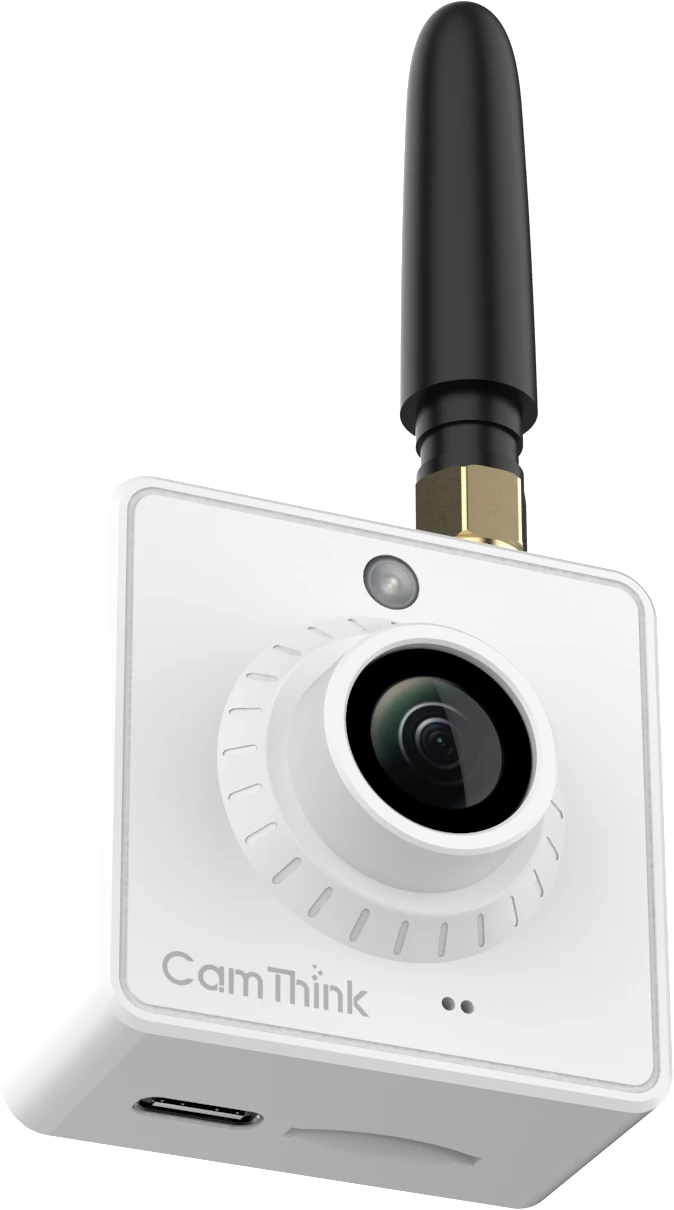
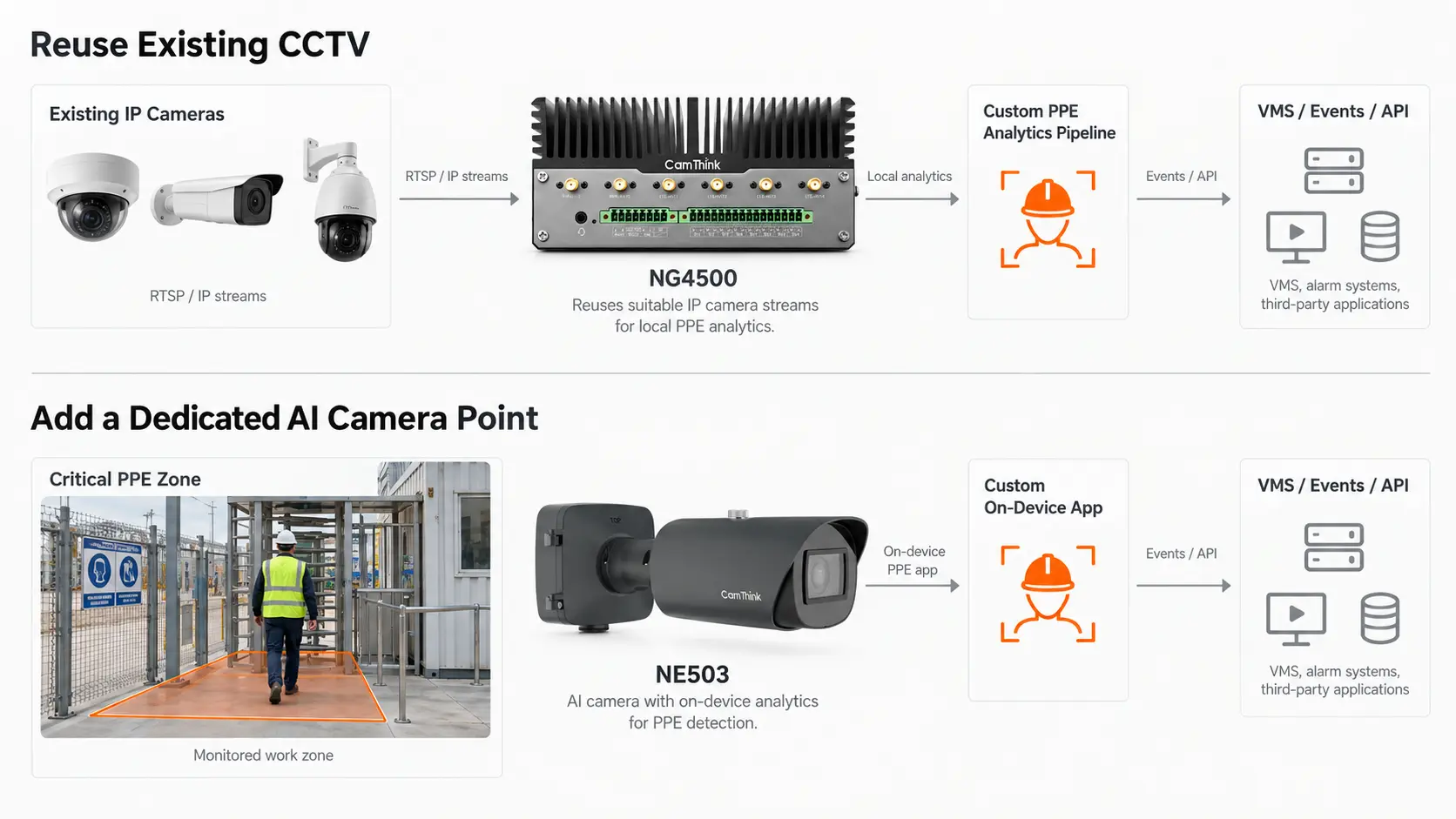
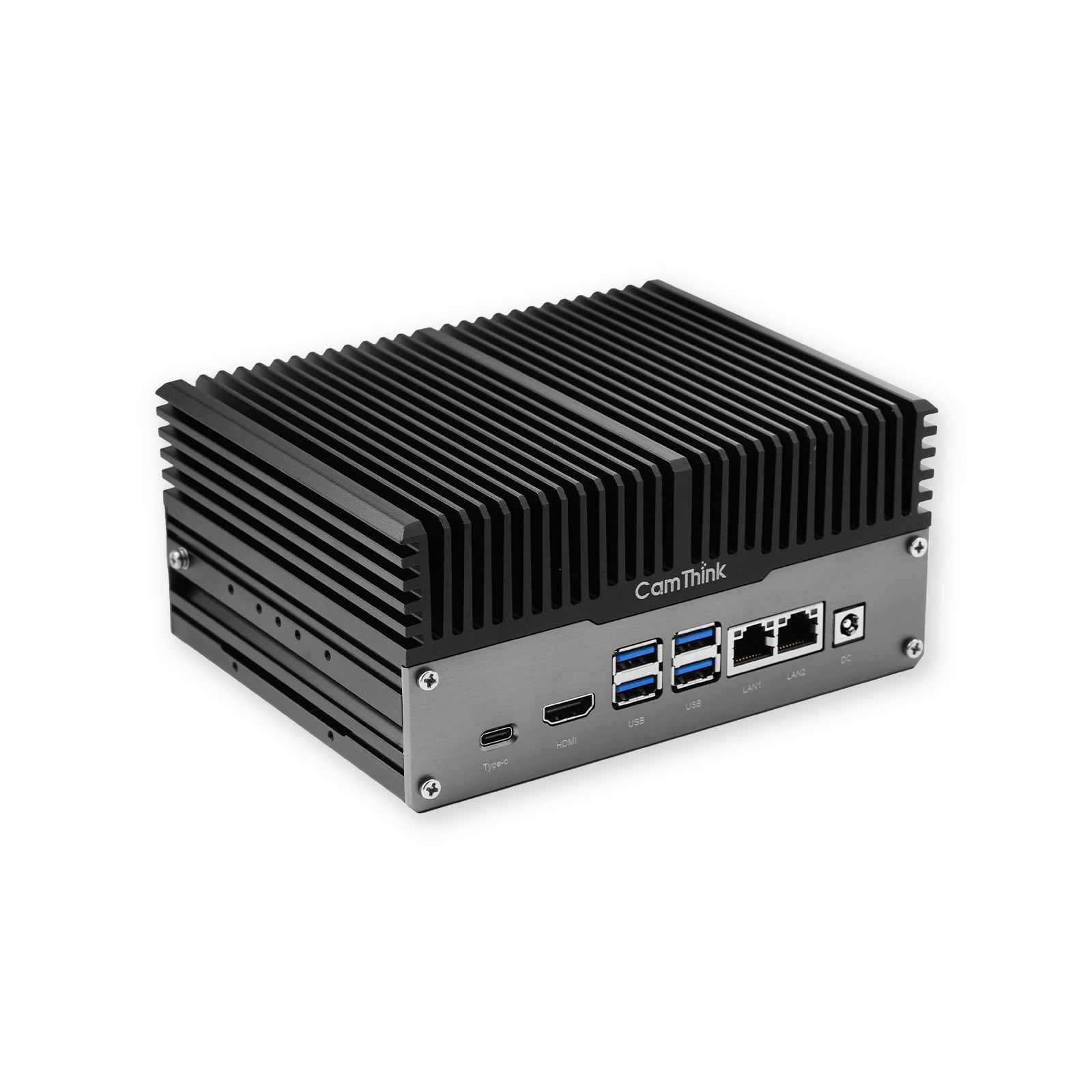
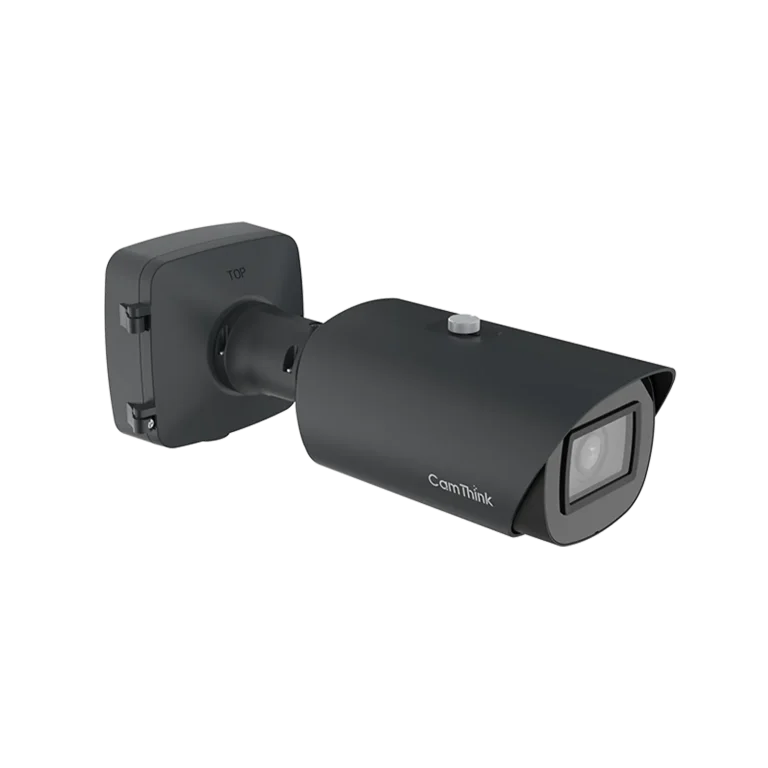
For a suitable set of installed IP streams, CamThink's NeoEdge NG4500 provides a Jetson Orin platform for developing and running local vision pipelines without replacing every camera. Where the needed view is missing, NeoEyes NE503 can be evaluated as a new camera point with 4K imaging and on-device inference. Neither device turns an untested view into a validated PPE application by itself; the model, zone logic, integration, and site acceptance still have to be built around the task.
Define the Safety Decision Before Choosing a Model
“Detect missing PPE” does not tell an integrator what to deliver. A usable rule names the equipment, the people to whom it applies, the place and time it applies, and the action that follows. For example: when a person crosses into a marked loading area without a visible hard hat, create one reviewable event for the shift supervisor after the condition persists long enough to reject a brief obstruction. That description tells the team where to put the counting line, which frames to label, and what the event must contain.
Helmet and vest are separate checks. A site may require both at an entry but only a vest in a traffic aisle. A visitor wearing a white bump cap may have a different approved rule from a contractor wearing a hard hat. Translate the site's actual policy into application labels and exceptions before tuning a model. When the item is hidden by a machine, a carried box, or another worker, record an uncertain case rather than treating invisibility as a confirmed violation.
The operational goal is a useful prompt for review, not a claim of legal or procedural compliance. A PPE event can help supervisors focus attention and document a response; it should not silently replace training, physical controls, or the site's own safety authority. This distinction also keeps the acceptance test honest: count whether the system produced the right event for the defined rule, not whether a detector drew a box somewhere in the frame.
Choose the First Camera and Zone to Test
Map candidate cameras to the rule, not the other way around. Place the zone or crossing line on representative frames and ask whether a worker is visible before, during, and after the decision point. A camera overlooking a gate may show the person's head and torso consistently. A high ceiling camera may show the top of a helmet but hide the front of a vest. An oblique side view may reveal a vest but lose the head behind shelving or vehicles. These differences change which PPE classes the view can support.
An entry checkpoint usually produces a contained first scope: one camera, one required item or item pair, one rule, and one receiving system. It also makes it easier to compare the AI event with a manual observation. An active work cell has a different job. Workers bend, turn, carry objects, and disappear behind equipment; a static image of a compliant worker at the center of the scene is weak evidence for the full workflow. If that work cell is the real business priority, test those movements from the outset rather than using an easy doorway result to imply site-wide coverage.
Document three outcomes for each candidate view: usable as installed, usable after a capture or placement adjustment, or unable to show the required evidence. That small decision map gives the buyer a reason to reuse an existing feed or fund a new point. It also avoids turning a PPE discussion into a general CCTV replacement proposal.
Check Helmet and Vest Visibility at Model Input
Inspect the stream the edge application will actually receive. Record the source resolution, encoded stream, camera angle, distance to the smallest relevant worker, lighting by shift, motion blur, and common obstructions. Then examine sample frames after the same resize or crop planned for inference. A large VMS display can make an item appear clear even when the model input does not preserve enough detail to distinguish it from clothing or background.
Consider a simple scaling example, not a detection threshold. If a helmet occupies 18 pixels in a 1920-pixel-wide image and the full width is reduced to 640 pixels, it occupies about 6 pixels before any further blur or compression. A region-of-interest crop may preserve more detail, but it must still cover where the person enters the rule zone. The calculation does not predict accuracy; it shows why pixel evidence should be measured on the intended input rather than inferred from a camera's advertised resolution.
Test helmets and vests separately in daylight, low light, backlight, and the busiest normal shift. Include workers with different body sizes, approved equipment variants, rainwear, similar-colored clothing, and the poses the task actually requires. Review positive, negative, and uncertain examples. If a human reviewer cannot consistently tell whether the required item is present in the processed view, changing a confidence threshold is unlikely to solve the underlying capture problem. The existing-CCTV footage validation guide gives a broader method for selecting representative clips.
Turn PPE Detections into Reviewable Events
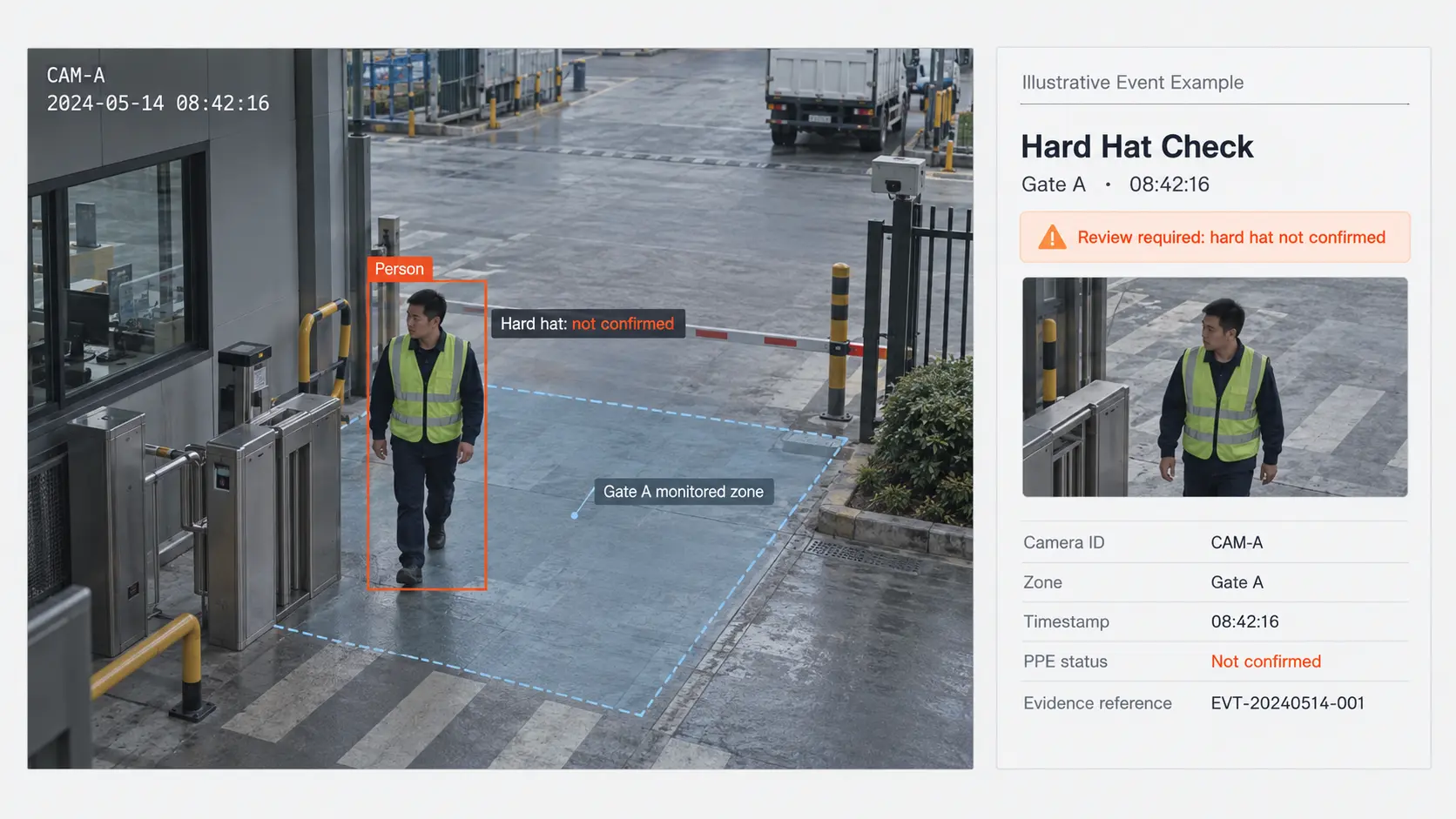
A PPE model is a component in a workflow, not the finished workflow. The application must associate an item with the right person, relate that person to the configured zone, and apply timing rules so one worker does not generate a burst of identical alerts. The event should identify the camera and zone, rule, observed time, relevant PPE class, decision state, and an evidence reference that a permitted reviewer can inspect. The receiving system needs a clear route to a supervisor, VMS queue, or site-approved action.
Detector boxes and counts are one step short of the alert a safety team needs. After the application checks the person, zone, and persistence rule, a pilot could send a record like this to a VMS or supervisor queue. This is an illustrative alert format, not an output shown in the NE503 developer example below.
CamThink's PPE model card lists helmet, vest, head, and no_vest classes with ONNX and PyTorch downloads. It is a PoC starting point, not a PPE application ready to deploy: target-hardware adaptation, person/zone/event logic, and the stated AGPL-3.0 obligations for intended commercial use still need review.
Specify how the system behaves when the stream is interrupted or the worker's head is hidden. Marking an event uncertain, holding the last trustworthy state for a defined interval, or requesting human review are different product behaviors; choose the one that fits the operation. A local alarm should follow the site's approved response design, not fire on every weak frame. This is where an integrator's rule design creates value beyond a generic detector demo.
Use NG4500 to Reuse Suitable IP Camera Streams
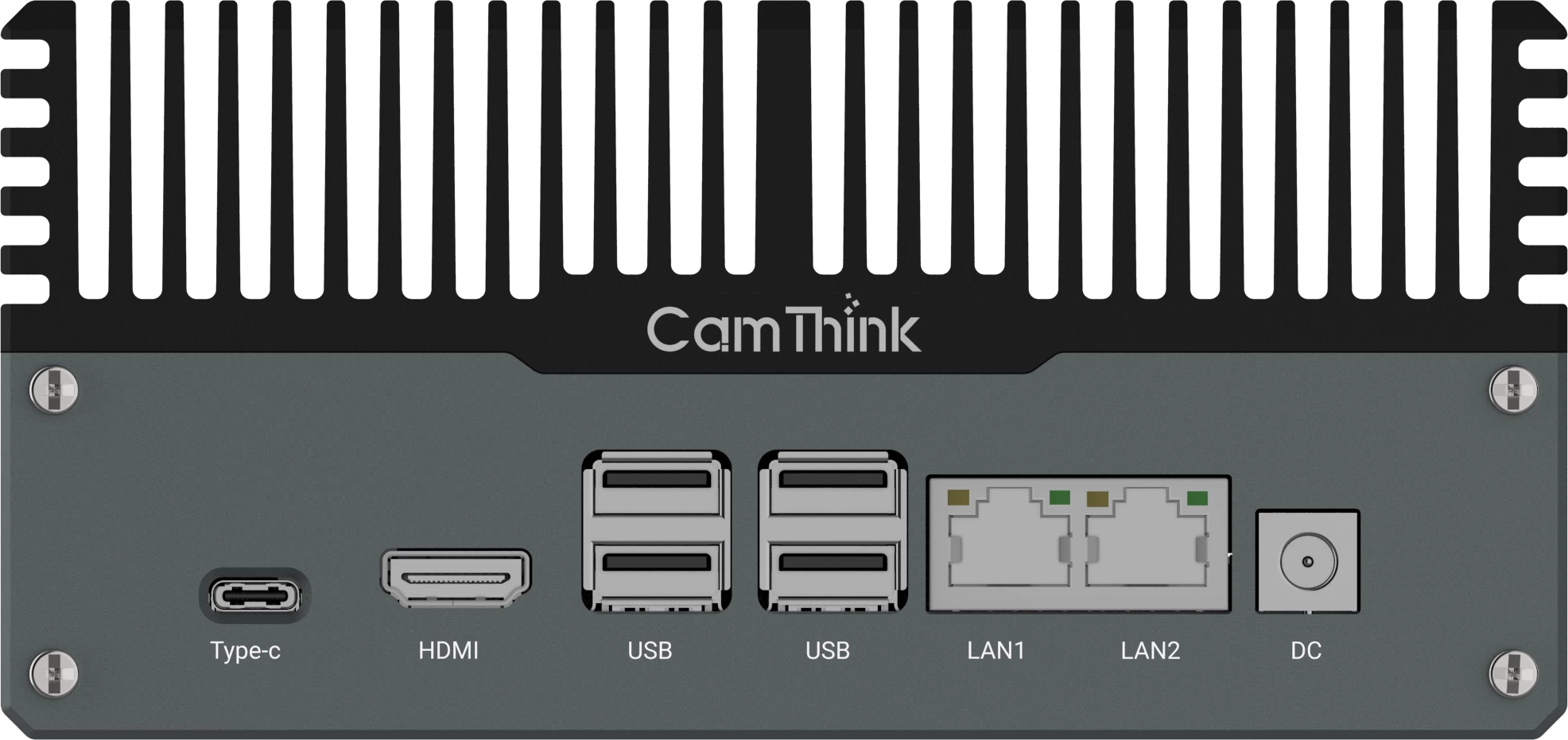
NG4500 is the natural starting platform when several existing cameras have useful views and accessible IP streams. Its Jetson Orin hardware and JetPack-based development environment support building a local multi-stream pipeline for inference, tracking, rule logic, and event delivery. The cameras can continue serving the site's recording system while the selected streams are evaluated for a new safety workflow. This lets an integrator demonstrate value from an existing estate without claiming every camera is suitable.
Plan the first deployment around measured workload, not a brochure stream maximum. Source codec, image size, frame rate, preprocessing, chosen model, number of zones, event evidence, and latency target all affect capacity. Start with one or two representative feeds, measure end-to-end behavior, then size expansion using the same pipeline. CamThink's edge-box sizing guide owns the broader capacity calculation; this article's point is to prove the PPE event before scaling camera count.
A standard NG4500 configuration is a practical test and development starting point; once the rule and workload are measured, the integrator can assess the appropriate hardware and integration configuration with CamThink.
Add NE503 Where the Camera View Is the Limitation
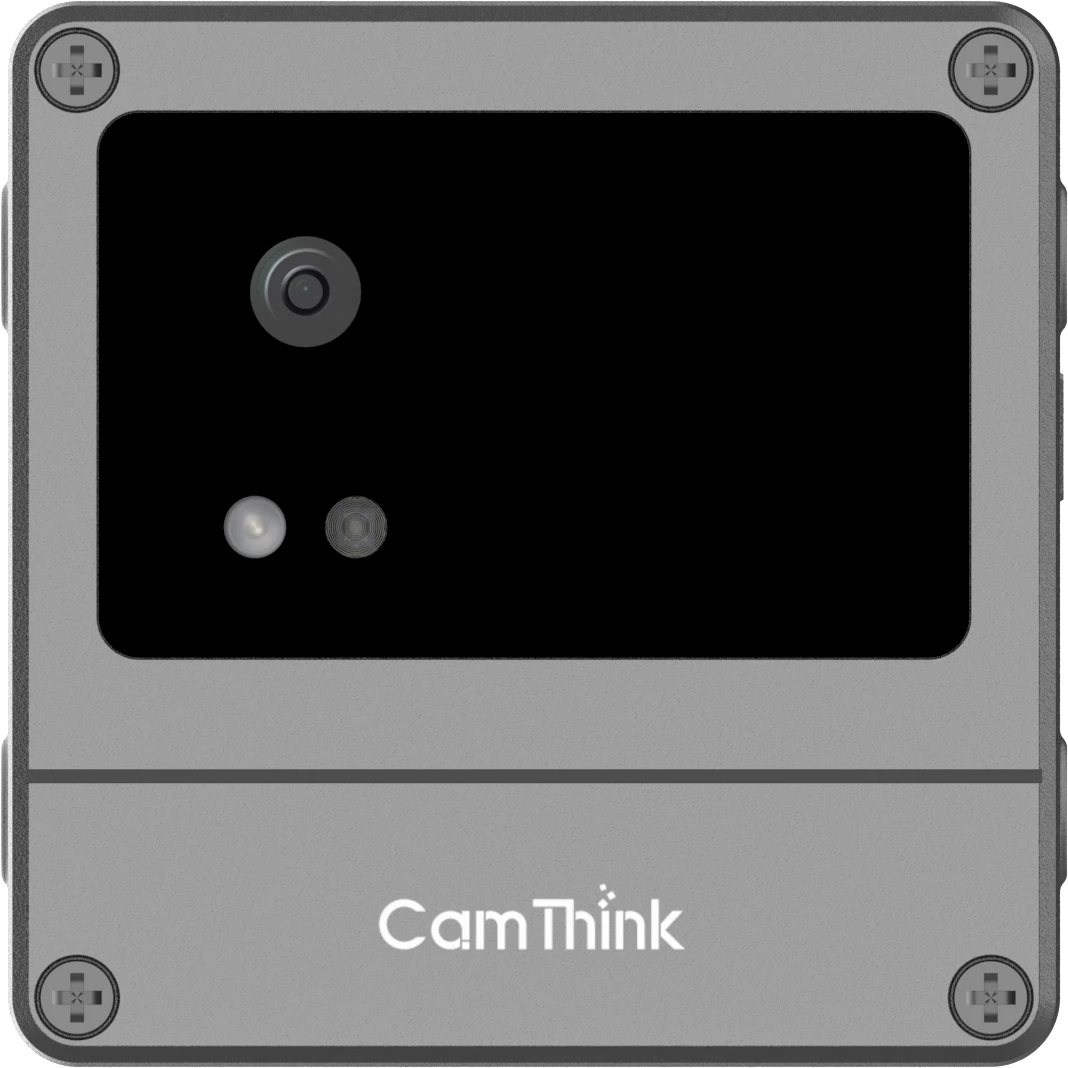
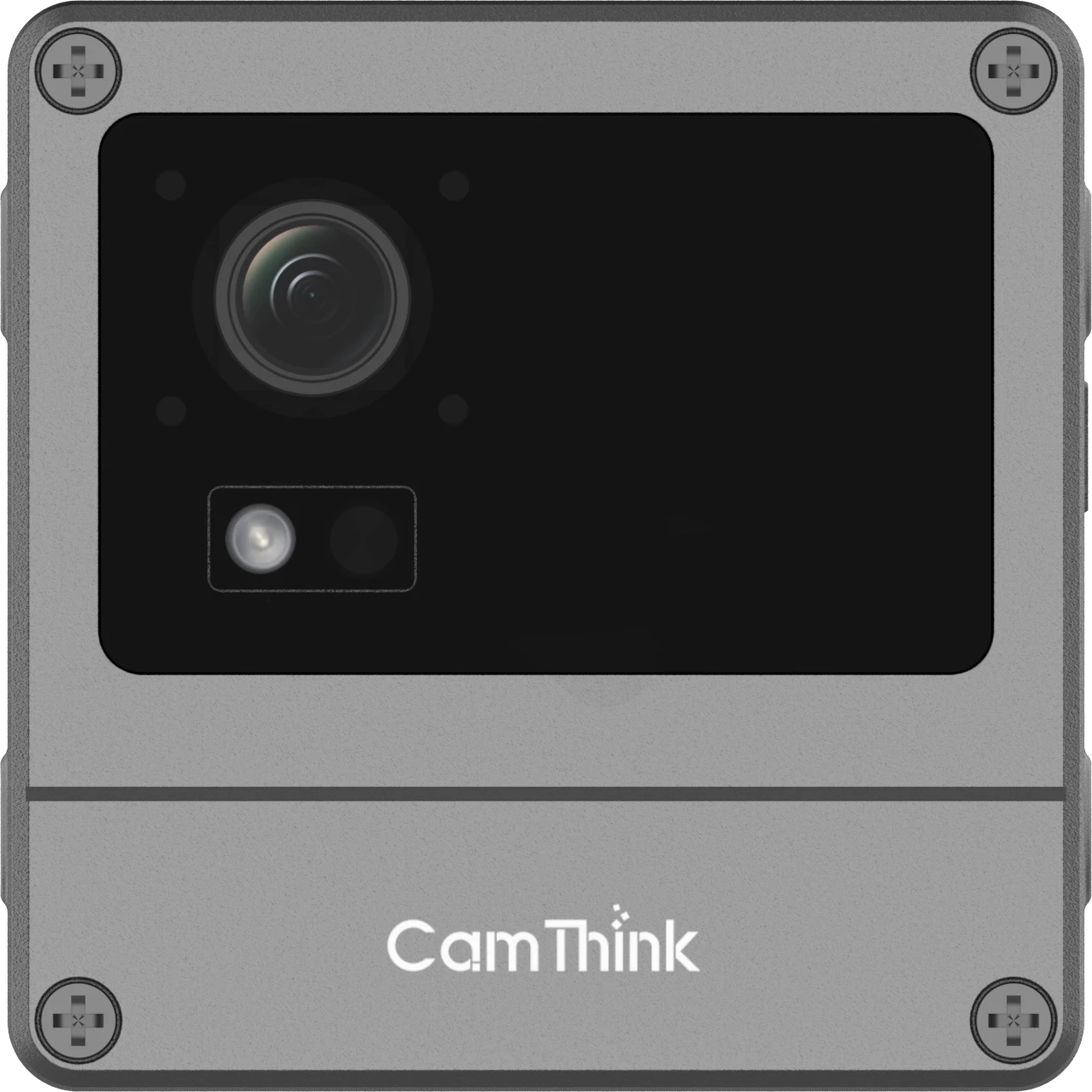
Add a dedicated point when an important entrance or work zone cannot provide the visual evidence from existing CCTV. NE503 combines a 4K imaging system, Hailo-15H inference platform, containerized application runtime, and structured event interfaces in an IP67 camera. That combination can put capture, application logic, and output at the checkpoint itself. It is especially relevant when the project needs a purpose-placed camera rather than another server-side model applied to an unsuitable overview view.
Choose the lens and mounting position for the person size and movement path that matter. A 4K sensor will not recover a head hidden by a rack, and an outdoor-ready enclosure does not make a bad angle useful. Validate the chosen view with the same rule and event criteria as the reused feeds. The PPE application still has to be deployed and tested; the camera is an open platform for the project, not a factory-certified safety decision.
A mixed plan is often the most economical technical answer: keep NG4500 on the selected existing feeds and use NE503 only where a new angle closes a known gap. The decision is backed by the view map and pilot evidence, not by a default preference for an edge box or an AI camera. This gives the customer a purchase case tied to a particular area and measurable result.
Developer-Proven Example: Safety Helmet Detection on NE503
CamThink's developer project trained a custom YOLOv8n helmet model, separate from the Model Zoo YOLOv8s download, compiled it for NE503's Hailo-15H, and debugged the runtime until live detections reached the Event Bus. One captured frame reported nine people: six with helmets and three without; object records include class, confidence, and bounding box. This demonstrates a working NE503 development path; a site deployment still needs a suitable view, zone rules, alert handoff, and acceptance testing.
The full Hackster guide covers the training, compilation, deployment, and debugging process.
Run a PoC That Answers the Buying Question
The pilot should answer whether the proposed configuration can produce events the site will act on at an acceptable review workload. Build a labeled set from the chosen camera and rule: compliant and noncompliant passages, normal variations of approved PPE, shift changes, busy periods, and the hard occlusions. Keep some sequences out of tuning so the final check is not performed only on clips the team has already optimized around. For a work-zone project, include bending, turning, carrying objects, and temporary disappearance behind machinery.
Measure at the event level. Count missed noncompliant entries, false alerts on compliant workers, time from rule satisfaction to delivered event, duplicate events for one passage, and cases correctly marked uncertain. Report results by camera, PPE item, zone, and operating condition. A single frame-level accuracy percentage hides the situations that drive supervisor workload and customer trust. Agree on target values with the HSE owner before the final pilot run; different sites can reasonably tolerate different delays and review volumes.
Test the handoff as well as the model: does the VMS or receiving platform show enough context for a reviewer, does an interrupted stream recover, and does the system avoid replaying stale alarms after reconnect? Record which views pass, which need a camera change, and which PPE classes remain outside the validated scope. That concise decision record gives the integrator evidence for a phased proposal and gives the buyer a defensible reason to fund the next stage.
PPE Detection PoC — Preparation Checklist
Define one PPE rule, the zone or crossing line, and who will review an alert.
Select one or two candidate IP streams; record access method, codec, resolution, and frame rate.
Provide day and night clips with compliant, missing-PPE, and obscured cases at the decision point.
Mark the required helmet or vest in frames at the intended model input size; note where the existing view fails.
Agree on the event fields, receiving VMS or platform, and acceptable misses, false alerts, and delay.
Can I add PPE detection to my existing CCTV cameras?
Yes, when an accessible IP stream preserves enough detail to see the worker and required PPE at the rule zone. Test representative frames from the actual stream before including that camera in the pilot.
Do I need to replace my cameras for PPE detection?
Not necessarily. Reuse suitable views with NG4500; evaluate a dedicated NE503 point only where a critical helmet or vest check cannot be seen in the existing view.
How many CCTV cameras can an edge AI box process?
There is no reliable camera count without the workload. Measure the chosen model, codec, resolution, frame rate, preprocessing, and event latency on representative NG4500 streams, then size the next group from that result.
Is PPE detection ready to use on NG4500 or NE503?
NG4500 and NE503 are application platforms, and CamThink provides a downloadable PPE model resource. A deployable site application still needs hardware adaptation, PPE and zone rules, alert integration, license review, and acceptance testing. The NE503 helmet tutorial demonstrates a working detector, not a prevalidated site-wide PPE system.
Choose the Next Step from the Pilot Result
Pilot finding
Next commercial and technical step
Existing views show the required PPE and event quality is acceptable
Expand selected streams on NG4500, size the measured workload, and integrate the approved review path.
One high-value checkpoint fails because the item is too small or hidden
Keep usable CCTV and evaluate an NE503 view at that checkpoint.
The image is usable but events are noisy
Improve person-to-item association, zone timing, labels, and review rules before buying more cameras.
The requested item cannot be observed in the available view
Change capture geometry or narrow the monitoring claim; do not sell a model-only fix.
The pilot result should identify reusable camera feeds, a reviewable PPE event, and any checkpoint that needs a new view. That gives the integrator a defined scope for a phased rollout instead of a general camera-replacement proposal.
HH
Harry Hua
Technical Director at CamThink
Harry works on edge AI camera platforms, video analytics deployment, and the integration of embedded vision systems with real operational workflows. Connect with Harry on LinkedIn.
Plan a Focused PPE Pilot
Start with one zone rule, a few representative day and night views, and the system that will receive an event. CamThink can help you assess an NG4500 evaluation or a targeted NE503 camera point.